
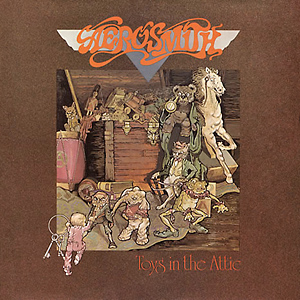
Toys in the Attic
By Aerosmith
The Story
Toys in the Attic was the album that turned Aerosmith from a rising Boston hard rock band into one of the major American rock acts of the 1970s. Released in 1975 by Columbia Records, it was the band's third studio album and the record where the classic lineup of Steven Tyler, Joe Perry, Brad Whitford, Tom Hamilton, and Joey Kramer fully sharpened its identity. Their first two albums had already shown their debt to blues, British rock, and dirty American rhythm and blues, but Toys in the Attic gave that sound a tighter, brighter, and more confident studio form.
The album was recorded at the Record Plant in New York City with producer Jack Douglas, who had also worked with the band on Get Your Wings. Douglas helped Aerosmith develop material before entering the studio, pushing them to arrange more carefully while preserving the live-band aggression that made them exciting. The group had become stronger from touring, and the record reflects that: the performances are lean, loud, and full of swagger, but the songs are more focused than before.
The title track opens the album with speed and nervous energy, immediately setting a sharper pace than much of Aerosmith's earlier work. 'Sweet Emotion', built around Tom Hamilton's bass line and a tense, slowly unfolding arrangement, became one of the band's signature songs and helped push the album into the mainstream. 'Walk This Way' was even more important. Joe Perry developed its riff during a soundcheck in Hawaii, and Steven Tyler later completed the lyrics after the band and producer Jack Douglas took a break to see Mel Brooks' Young Frankenstein; the film's phrase 'walk this way' helped give the song its title. Tyler's rhythmically packed vocal phrasing made the track feel unusually close to funk and rap-like wordplay before hip-hop had entered rock radio.
Toys in the Attic also showed Aerosmith's range. 'Big Ten Inch Record' reached back to old jump blues through a cover of Bull Moose Jackson's song, while 'No More No More' gave the album one of its clearest looks at the exhausting side of life on the road. 'Round and Round' leaned heavier and darker, and the closing 'You See Me Crying' brought in orchestral drama, showing that the band could aim beyond raw barroom rock without losing its identity.
The album became Aerosmith's commercial breakthrough and eventually one of their best-selling records. Its success was driven by 'Sweet Emotion' and 'Walk This Way', but its importance goes deeper than its singles. Toys in the Attic captured the band at the moment when their sleazy blues-rock attitude, twin-guitar force, and Steven Tyler's flamboyant vocal style became unmistakably their own. It remains one of the defining American hard rock albums of the 1970s and the clearest bridge between Aerosmith's hungry early years and their later arena-sized fame.