
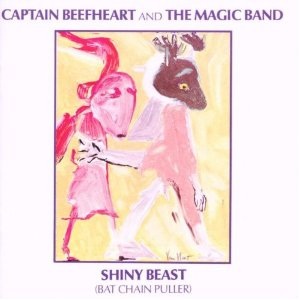
Shiny Beast (Bat Chain Puller)
The Story
Shiny Beast (Bat Chain Puller) marked a major return for Captain Beefheart after a difficult and uneven mid-1970s period. Released in 1978, the album followed the more commercial but controversial records Unconditionally Guaranteed and Bluejeans and Moonbeams, which had alienated many longtime listeners and even led to the departure of key Magic Band members. With Shiny Beast, Don Van Vliet reconnected with the stranger, sharper, and more rhythmically inventive side of his work while also presenting it in one of his most colorful and approachable forms.
The album is closely tied to the complicated history of Bat Chain Puller, an earlier album recorded in 1976 but left unreleased for decades because of legal and business disputes involving Frank Zappa and Herb Cohen. Rather than simply abandon the material, Beefheart returned to many of those songs and reworked them for Shiny Beast. This gives the album an unusual place in his catalog: it is both a comeback record and a partial reconstruction of a lost project.
Musically, Shiny Beast balances Beefheart's avant-garde instincts with a brighter and more playful sound. The Magic Band arrangements remain angular and unpredictable, but the production is clearer and warmer than the extreme density of Trout Mask Replica or Lick My Decals Off, Baby. Songs like 'The Floppy Boot Stomp' and 'Bat Chain Puller' carry the jagged blues-based rhythms and surreal language associated with Beefheart's classic work, while 'Tropical Hot Dog Night' brings an almost carnival-like swing, showing his ability to make strange music feel inviting.
The album also reveals a wide emotional range. 'Harry Irene' is one of Beefheart's most gentle and melodic songs, built around a simple, old-fashioned charm that contrasts with the more fractured pieces around it. 'When I See Mommy I Feel Like a Mummy' and 'Apes-Ma' return to his stranger lyrical world, filled with absurd images, odd phrasing, and vocal performances that feel closer to theater than conventional rock singing. Instrumental pieces such as 'Ice Rose' and 'Suction Prints' highlight the precision and personality of the band, showing how Beefheart's music depended not only on eccentric ideas but on highly disciplined musicianship.
Compared with his most difficult albums, Shiny Beast is easier to enter, but it does not dilute what made Captain Beefheart unique. The songs are tighter, the textures are more spacious, and the humor is more visible, yet the music still refuses standard rock logic. Its rhythms bend and lurch, guitars interlock in unexpected ways, and Beefheart's voice moves between blues growl, spoken-word command, and surreal character performance.
In retrospect, Shiny Beast (Bat Chain Puller) stands as one of Captain Beefheart's strongest later albums. It restored much of the artistic credibility that had been shaken earlier in the decade and opened the final major phase of his recording career, leading toward Doc at the Radar Station and Ice Cream for Crow. It is a vivid example of Beefheart's ability to turn blues, absurdity, discipline, and imagination into a musical language that belonged entirely to him.