
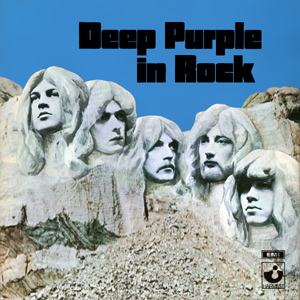
Deep Purple in Rock
By Deep Purple
The Story
Deep Purple in Rock was the album that fully introduced the classic Mark II lineup of Deep Purple as a new kind of hard rock force. Released in 1970, it was the band's fourth studio album and the first studio LP made by Ritchie Blackmore, Ian Gillan, Roger Glover, Jon Lord, and Ian Paice. The arrival of Gillan and Glover in 1969 changed the band's chemistry, pushing them away from the more psychedelic and progressive leanings of their earlier records and toward a heavier, more aggressive sound built to match the power of their live performances.
Work on the album began after the new lineup rehearsed at Hanwell Community Centre in London, where the band shaped songs through volume, repetition, and stage testing. Deep Purple wanted the record to sound loud, direct, and physically intense. Recording took place between late 1969 and early 1970 at London studios including IBC, De Lane Lea, and Abbey Road, with the band producing the album themselves. The result was rawer and more unified than their previous studio work, centered on the dramatic tension between Blackmore's guitar, Lord's distorted organ, Paice's urgent drumming, Glover's bass, and Gillan's high, forceful vocals.
'Speed King' opened the album with an explosive statement of intent, drawing on old rock and roll phrases while turning them into something faster and heavier. 'Bloodsucker' and 'Into the Fire' kept the music compact and abrasive, while 'Flight of the Rat' and 'Hard Lovin' Man' stretched the band's attack into longer, more frantic forms. 'Hard Lovin' Man' was also an important recording moment because engineer Martin Birch worked with the group on it; he would remain closely associated with Deep Purple through several of their major 1970s albums.
The centerpiece was 'Child in Time', a long, dramatic piece that became one of Deep Purple's defining songs. Built from a slow, haunting organ progression and rising through Gillan's extraordinary vocal screams into a heavy instrumental climax, it captured the band's ability to combine classical-minded drama, blues-rock force, and almost theatrical intensity. The song became a live staple and one of the clearest examples of why the Mark II lineup felt so different from the earlier Deep Purple.
Although the single 'Black Night' was recorded around the same period and became a major UK hit, it was not part of the original standard album track list. Deep Purple in Rock itself became the band's breakthrough in Britain and Europe, reaching number four on the UK Albums Chart and remaining on the chart for a long stretch. Its heavier direction helped establish the sound that Deep Purple would refine on Fireball and Machine Head. More than just a lineup debut, In Rock was the moment Deep Purple became one of the central bands in early 1970s hard rock and a major influence on the development of heavy metal.