
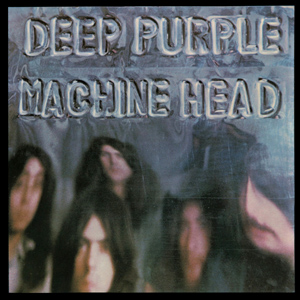
Machine Head
By Deep Purple
The Story
Machine Head is the Deep Purple album most closely associated with the classic Mark II lineup at full force: Ritchie Blackmore on guitar, Ian Gillan on vocals, Roger Glover on bass, Jon Lord on organ, and Ian Paice on drums. Released in 1972, it was the band's sixth studio album and one of the defining hard rock records of the decade. Deep Purple wanted to make an album away from the usual studio environment, using the Rolling Stones Mobile Studio in Montreux, Switzerland, in the hope of capturing more of the power and immediacy of their live sound.
The sessions became famous because almost everything went wrong before the band found the sound they needed. Deep Purple had planned to record at the Montreux Casino, but just before their sessions were due to begin, the casino caught fire during a Frank Zappa and the Mothers of Invention concert after an audience member fired a flare gun into the building. The fire destroyed the venue and forced the band to search for another place to work. They tried recording at a nearby theatre, but noise complaints brought that attempt to an end. Eventually they set up in the closed Grand Hotel, placing equipment in corridors and connecting the band to the mobile studio parked outside.
That difficult setup became part of the album's character. Machine Head sounds direct, heavy, and alive, with the band relying on strong performances rather than studio polish. 'Highway Star' opens the album with speed and precision, turning the image of a fast car into one of Deep Purple's most durable concert pieces. 'Maybe I'm a Leo' and 'Pictures of Home' show the band's sense of groove and ensemble interplay, with Blackmore's guitar and Lord's organ often acting like two lead instruments. 'Never Before' was considered one of the album's more commercial tracks and was released as a single.
'Smoke on the Water' turned the chaos of the Montreux sessions into rock history. Its lyrics recount the casino fire, the smoke over Lake Geneva, and the band's move to the Grand Hotel, while Blackmore's simple, heavy riff became one of the most recognizable guitar figures ever recorded. The song was not initially treated as the album's obvious hit, but it later became Deep Purple's signature track and helped carry Machine Head to a wider audience.
The second side also shows why the album endured beyond one famous song. 'Lazy' stretches into a blues-based showcase for Lord, Blackmore, and Gillan, while 'Space Truckin'' closes the album with a driving science-fiction rock-and-roll energy that became another live favorite. Machine Head topped the UK Albums Chart and became one of Deep Purple's most commercially successful albums. Its lasting importance comes from how completely it captures the band's strengths: volume, virtuosity, groove, organ-guitar tension, and the feeling of a live rock band turning pressure and disruption into a classic record.