
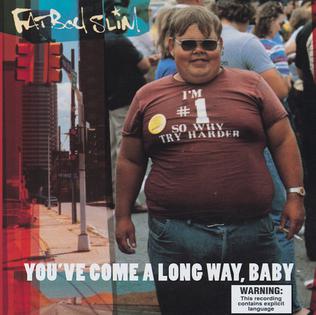
You've Come a Long Way, Baby
By Fatboy Slim
The Story
You've Come a Long Way, Baby was the album that turned Norman Cook's Fatboy Slim project into a worldwide symbol of late-1990s big beat. Released in the UK by Skint Records in October 1998 and in the US by Astralwerks the following day, it followed Better Living Through Chemistry but reached a much larger audience. Cook recorded and produced the album in Brighton at his home studio, the House of Love, building tracks from sampled fragments, hard dance rhythms, rock-and-roll energy, and a deliberately playful sense of excess.
The album's title came from a cigarette advertising slogan, and the cover art pushed the same cheeky, provocative attitude. The original UK sleeve used a photograph of a large man wearing a shirt that reads 'I'm #1 so why try harder', while the North American edition used different artwork showing shelves of records. That visual identity matched the music: loud, funny, sample-heavy, immediately physical, and proud of its own cartoonish confidence.
Musically, You've Come a Long Way, Baby captured big beat at its commercial peak. Cook worked with a limited but effective setup, drawing from obscure records and assembling grooves on samplers and computer equipment rather than making polished club music from scratch. The result was a record that felt like DJ culture translated into pop form: breaks, slogans, distorted bass, repeated hooks, sudden jokes, and tracks designed to hit hard in clubs, on radio, and in advertisements.
The singles defined the album's reach. 'The Rockafeller Skank' became a signature Fatboy Slim track, built around its famous repeated vocal hook and a pile-up of surf, funk, and breakbeat energy. 'Gangster Tripping' kept the formula rough and kinetic, while 'Right Here, Right Now' gave the album one of its most dramatic moments, turning a huge build into a widescreen anthem. 'Praise You' became the record's most human and surprising hit, pairing a warm vocal sample with a loose, handmade feel. Its Spike Jonze-directed video, staged as an amateur dance performance in a public space, became one of the era's most memorable music videos and helped the song cross beyond dance audiences.
The album was not subtle, and it was never trying to be. Tracks such as 'Build It Up, Tear It Down', 'Kalifornia', 'You're Not from Brighton', and 'Acid 8000' show Cook's taste for repetition, noise, humor, and momentum. Yet the album's success came from how efficiently it turned that chaos into hooks. It made sample-based electronic music feel approachable without removing its rough edges.
You've Come a Long Way, Baby reached number one on the UK Albums Chart, brought Fatboy Slim major international attention, and produced several UK top-ten singles. It became one of the defining albums of the big beat era, alongside work by acts such as The Chemical Brothers and The Prodigy, but its personality was uniquely Cook's: less dark, less aggressive, more mischievous, and built around the idea that a dance record could be both massive and ridiculous. Decades later, it remains the clearest document of Fatboy Slim's pop breakthrough and of a moment when breakbeats, samples, and club culture briefly took over the mainstream.