
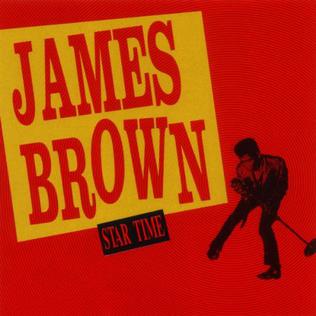
Star Time
By James Brown
The Story
Star Time is not a conventional studio album but a four-disc box set released in 1991 that serves as the most comprehensive overview of James Brown’s career. This distinction is important because, unlike many artists who can be defined by a single landmark album, James Brown’s influence was built primarily through individual singles released across decades. His music evolved continuously, and his most important recordings were often standalone releases rather than parts of cohesive studio albums. Because of this, Star Time is widely regarded as the closest equivalent to a definitive James Brown album, offering a curated narrative of his development from the 1950s through the 1980s.
The first disc focuses on Brown’s early years, when his music was rooted in gospel and rhythm and blues. Songs like 'Please Please Please' and 'Try Me' highlight his emotional vocal delivery and the influence of gospel phrasing, which became central to his style. Early albums such as Please Please Please (1958) and Try Me! (1959) established him as a powerful performer, but even then, his emphasis on rhythm and stage energy hinted at something more transformative. His live performances, particularly those captured on Live at the Apollo (1963), played a crucial role in building his reputation and demonstrated a level of intensity that few artists could match.
The second disc captures the moment when James Brown began to change the structure of popular music. In the mid-1960s, with songs like 'Papa's Got a Brand New Bag' and 'I Got You (I Feel Good)', he shifted the focus from melody to rhythm. Instead of traditional chord progressions, Brown emphasized groove, repetition, and tight interaction between instruments. Albums such as Out of Sight (1964) and Papa's Got a Brand New Bag (1965) reflect this transition, marking the early stages of funk. This innovation fundamentally altered how rhythm sections functioned in popular music.
By the late 1960s, represented across the second and third discs, Brown had fully developed the funk style. 'Cold Sweat' is often cited as one of the first true funk recordings, built almost entirely around rhythm and syncopation. Songs like 'Say It Loud – I'm Black and I'm Proud' connected his music to the civil rights movement, making him not only a musical innovator but also a cultural voice. Albums such as I Got the Feelin' (1968) and Say It Loud – I'm Black and I'm Proud (1969) show how his work combined musical experimentation with social commentary.
The third disc highlights the peak of his funk innovations in the early 1970s. Tracks such as 'Get Up (I Feel Like Being A) Sex Machine', 'Super Bad', and 'Soul Power' demonstrate a fully realized groove-based approach, where repetition and rhythm became the primary driving forces. Albums like Sex Machine (1970), Hot Pants (1971), and There It Is (1972) illustrate how Brown refined this sound, influencing countless musicians. His band during this period, featuring players such as Bootsy Collins and Maceo Parker, became central to his identity, functioning as a tightly synchronized rhythmic unit.
The fourth disc extends into the 1970s and early 1980s, showing how Brown continued to adapt his sound while maintaining his core identity. Songs like 'The Payback', 'Get on the Good Foot', and 'Get Up Offa That Thing' reflect his ability to remain relevant while influencing emerging genres. His rhythmic innovations became foundational for hip-hop, with many of his recordings later becoming some of the most sampled in music history.
Star Time ultimately serves as a historical document rather than a single artistic statement. It brings together recordings from across James Brown’s career, allowing listeners to trace his evolution from a gospel-influenced R&B singer into the creator of funk and one of the most influential figures in modern music. By including material from key studio albums such as Please Please Please, Out of Sight, Cold Sweat, Sex Machine, and The Payback, the compilation provides context for how his sound developed over time.
For an artist whose legacy cannot be contained within one album, Star Time stands as the most complete representation of his work. It captures not just a collection of songs, but the evolution of an artist who reshaped rhythm, performance, and the structure of popular music itself.