
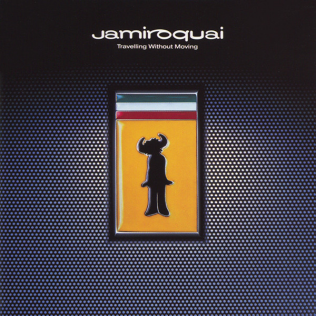
Travelling Without Moving
By Jamiroquai
The Story
Travelling Without Moving arrived as Jamiroquai's third studio album and the record that turned the British funk and acid-jazz group from a major UK act into an international pop phenomenon. Released first in Japan on 28 August 1996 and then in the UK in September, the album was recorded at Great Linford Manor in Milton Keynes and produced by Jay Kay with Al Stone. It kept the band's foundation in 1970s-inspired funk, soul, jazz-funk, and disco, but gave those elements a cleaner, more immediate pop shape than on the group's earlier albums.
Jay Kay described the album's world as revolving around cars, life, and love, and that idea shaped both the music and the packaging. The cover adapted the band's Buffalo Man logo into a design that deliberately echoed the look of a luxury sports-car badge, while the title track even used the sound of Kay's Lamborghini in its introduction. That car imagery became part of the album's identity, though it also brought criticism because Jamiroquai's early reputation had been tied to ecological concern and social commentary. Kay and keyboardist Toby Smith both addressed that tension in interviews, acknowledging the contradiction rather than denying it.
Musically, the album balanced movement and polish. 'Virtual Insanity' opened the record with one of Jamiroquai's most recognizable statements: a sleek, piano-led groove with lyrics warning about technology, artificial living, and social disconnection. Its Jonathan Glazer-directed video, built around the illusion of a moving room, became one of the defining music videos of the 1990s and won four MTV Video Music Awards in 1997, including Video of the Year. The success of that clip helped push the album far beyond the band's existing audience.
The rest of the album showed how flexible Jamiroquai's style had become. 'Cosmic Girl' turned disco and funk into a bright, space-age dance single, while 'Alright' gave the album another upbeat club-facing moment. 'High Times' leaned into the darker side of fame and excess, and 'Drifting Along' brought in a relaxed reggae feel. The instrumental pieces 'Didjerama' and 'Didjital Vibrations' highlighted Wallis Buchanan's didgeridoo, a recurring part of Jamiroquai's early sound, while 'Spend a Lifetime' closed the core sequence with a warmer soul-ballad mood.
Travelling Without Moving became Jamiroquai's commercial peak. It reached number two on the UK Albums Chart, entered the US Billboard 200, and sold millions worldwide, with the album later widely cited as the best-selling funk album in history. Its importance lies not only in those numbers but in how it translated Jamiroquai's retro-minded musicianship into the language of 1990s pop culture: stylish videos, dance-floor singles, strong visual identity, and a sound that made old-school funk feel newly global.