
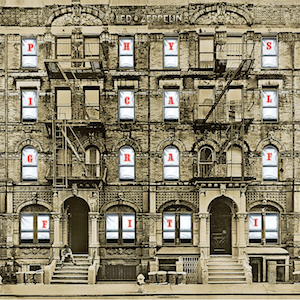

The Story
Released on February 24, 1975, Physical Graffiti was Led Zeppelin’s first album issued on their own Swan Song label and their only studio double album. Rather than being recorded in a single continuous set of sessions, the record combined newly written material with previously unreleased tracks from earlier recording periods, including sessions for Led Zeppelin III, IV, and Houses of the Holy. This approach allowed the band to assemble a broad retrospective of their evolving sound while also presenting new compositions developed during sessions at Headley Grange in 1974.
The album opens with Custard Pie, a riff-driven track that establishes a heavy tone. The Rover follows with layered guitars and a mid-tempo groove, originally developed during earlier sessions before being completed for this release. In My Time of Dying expands into a long, blues-based performance built around slide guitar and shifting sections, reflecting the band’s interest in extended arrangements. Houses of the Holy, despite sharing its name with the previous album, had not appeared on that record and adds a more concise, rhythm-focused structure.
Trampled Under Foot introduces a funk-influenced groove centered on keyboard patterns, highlighting John Paul Jones’s prominent role in shaping the track’s rhythmic foundation. Kashmir stands as one of the album’s central compositions, built around a repeating guitar figure and orchestral textures. The piece developed from ideas Jimmy Page and Robert Plant worked on while traveling, and its layered arrangement reflects the band’s interest in creating expansive, atmospheric soundscapes.
The second half of the album continues the stylistic diversity. In the Light blends synthesizer textures with gradual dynamic development, while Bron-Yr-Aur returns to acoustic guitar, echoing earlier folk-influenced material. Down by the Seaside shifts between softer passages and heavier sections, and Ten Years Gone features layered guitar arrangements built around reflective lyrics. Night Flight and The Wanton Song return to more direct rock structures, maintaining the album’s alternating pacing.
Boogie with Stu presents a loose, piano-driven performance, and Black Country Woman features a more informal acoustic feel. The album closes with Sick Again, a heavier track that returns to a straightforward rock approach. Across its four sides, Physical Graffiti moves between acoustic pieces, blues reinterpretations, funk-influenced grooves, and large-scale compositions.
By combining new recordings with material from multiple periods, Physical Graffiti functions both as a snapshot of Led Zeppelin in the mid-1970s and as a broader overview of their musical range. The double-album format allowed the band to present contrasting styles without narrowing the focus, resulting in a record that emphasizes variety, extended composition, and layered production. The album captures Led Zeppelin at a peak of creative scope, drawing together elements from across their earlier work while continuing to expand their sound.