
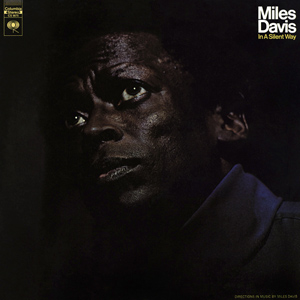
In a Silent Way
By Miles Davis
The Story
In a Silent Way marked one of the quietest revolutions in Miles Davis' catalog. Released by Columbia in 1969, it was recorded at CBS 30th Street Studio in New York on February 18 of that year, during a period when Davis was moving decisively away from the acoustic post-bop language of his 1960s quintet and toward electric texture, studio construction, and a looser relationship with rock, funk, and mood-based improvisation.
The album's lineup captured a remarkable moment of transition. Davis brought together musicians from his recent and future worlds: Wayne Shorter on soprano saxophone, John McLaughlin on electric guitar, Chick Corea, Herbie Hancock, and Joe Zawinul on electric keyboards, Dave Holland on bass, and Tony Williams on drums. Rather than building the album around conventional tunes with long chord sequences, Davis worked with vamps, tonal centers, fragments, and atmosphere. The music does not rush to prove itself. It opens space, lets patterns repeat, and allows small changes in color to become the drama.
Producer Teo Macero was central to the finished record. The music came from a single session, but the released album was not simply a document of that session played straight through. Macero edited, arranged, and repeated sections of the recordings to create two side-long suites. That approach was controversial in jazz at the time, where studio manipulation could be viewed as interference with live improvisation, but it became part of the album's importance. In a Silent Way helped show that the studio itself could be a compositional instrument in modern jazz.
The first side, 'Shhh / Peaceful', is built on restraint and pulse. Davis' trumpet enters with a fragile, almost whispered authority, while the electric keyboards shimmer around him and the rhythm section creates a steady, understated current. The second side joins Joe Zawinul's serene 'In a Silent Way' theme to Davis' 'It's About That Time', moving from stillness into a brighter, more active groove before returning to the opening calm. John McLaughlin's guitar lines, reportedly shaped by Davis' instruction to play as if he did not know how to play guitar, give the title section a stark and unusual simplicity.
In a Silent Way is often treated as the beginning of Davis' full electric period and a foundation stone of jazz fusion, but it is very different from the heavier, more turbulent sound of Bitches Brew, which followed in 1970. This album is softer, more spacious, and more meditative. Its radical quality lies in how little it forces: electric instruments are used for atmosphere rather than volume, improvisation is framed by editing rather than left entirely unshaped, and the music seems to hover between jazz, rock, minimalism, and ambient sound before those categories had fully settled. More than a stylistic experiment, it remains one of Davis' most beautiful statements of change.