
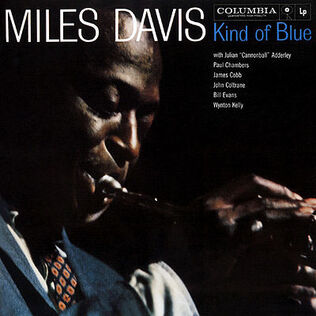
Kind of Blue
By Miles Davis
The Story
Kind of Blue is one of the rare albums whose reputation is matched by the simplicity of its creation. Miles Davis recorded it for Columbia in 1959 at the label's 30th Street Studio in New York, using two short sessions on March 2 and April 22. The band was extraordinary even by Davis's standards: John Coltrane on tenor saxophone, Cannonball Adderley on alto saxophone, Paul Chambers on bass, Jimmy Cobb on drums, Bill Evans on piano for most of the album, and Wynton Kelly on piano for 'Freddie Freeloader'.
The album arrived at a turning point in Davis's music. After the fast chord changes and virtuoso pressure of bebop and hard bop, he wanted a more open approach. Kind of Blue is usually described as the landmark recording of modal jazz because its pieces were built less around dense chord progressions and more around scales, modes, space, and melodic choice. Davis gave the musicians sketches rather than fully arranged compositions, leaving them room to shape the music in the moment. The result feels calm and inevitable, but it was also radical: the players were being asked to think horizontally, through mood and line, rather than simply move through preset harmonic changes.
'So What' opens the album with one of the most recognizable themes in jazz, a call-and-response figure that establishes the album's spacious character immediately. 'Freddie Freeloader' is the most blues-rooted piece on the record, and Davis used Wynton Kelly there instead of Evans, giving the track a more earthy swing. 'Blue in Green' is the album's most delicate ballad, strongly associated with Bill Evans's harmonic language, and it deepens the record's reflective atmosphere. The second side turns to longer, hypnotic forms: 'All Blues' rides a 6/8 groove that makes the music feel both elegant and physical, while 'Flamenco Sketches' closes the album with a sequence of modal colors that each soloist moves through at an unhurried pace.
Part of the album's mythology is that it sounds effortless, almost as if it had simply appeared. The truth is more precise: it was lightly prepared, but not careless. Davis chose musicians who could respond instantly, listen deeply, and create individual statements without breaking the album's unified mood. Coltrane brought searching intensity, Adderley brought bluesy warmth, Evans brought impressionistic harmony, and the Chambers-Cobb rhythm section kept everything grounded without crowding the soloists.
Kind of Blue became far more than a celebrated jazz record. It became one of the most widely heard albums in the history of the genre and a common entry point for listeners discovering jazz for the first time. Its influence can be heard in later jazz, rock, ambient music, film scoring, and any music that values atmosphere as much as structure. More than six decades after its release, the album still feels modern because it does not rely on force. Its power comes from restraint, tone, silence, and the confidence of musicians who knew exactly how much they did not need to play.