
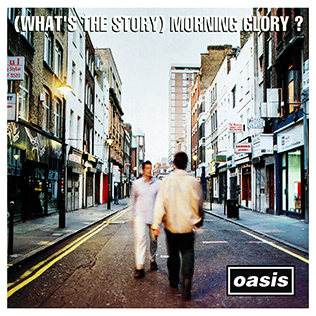
(What's the Story) Morning Glory?
By Oasis
The Story
(What's the Story) Morning Glory? was the album that turned Oasis from a fast-rising Manchester rock band into one of the defining British groups of the 1990s. Released in 1995 by Creation Records, it followed the explosive success of Definitely Maybe but moved away from that debut's rawer, more direct attack. Noel Gallagher, the band's main songwriter, produced the album with Owen Morris, and the sessions took place mainly at Rockfield Studios in Wales during a period when Oasis were becoming central to the Britpop era.
The album did not abandon the band's love of loud guitars, big choruses, and classic British rock lineage, but it widened the emotional frame. Where Definitely Maybe often sounded like escape, hunger, and swagger, Morning Glory gave Oasis a more anthemic and communal language. The songs were simpler in structure than some critics expected, but their strength came from scale: melodies built to be shouted by crowds, lyrics that mixed everyday phrasing with dreamlike optimism, and a production sound that made the band feel larger than life.
'Wonderwall' became the album's most widely recognized song, built around acoustic guitar, Liam Gallagher's restrained vocal, and a melody that crossed far beyond the band's original audience. 'Don't Look Back in Anger' gave Noel Gallagher a rare lead vocal and became one of Oasis' great singalong anthems, while 'Some Might Say' had already given the band their first UK number one single before the album arrived. 'Roll With It' became part of the famous 1995 chart battle with Blur's 'Country House', an event that turned Britpop into mainstream news and made Oasis' rivalry with Blur a national pop-cultural story.
The album also showed different sides of the band. 'Hello' opened with a brash sense of arrival, 'Cast No Shadow' offered a more reflective tribute to a figure worn down by fame and pressure, and 'She's Electric' brought a lighter, Kinks-like character-song energy. The title track and 'Champagne Supernova' pushed the record toward a more expansive, psychedelic mood, with the closing track becoming one of Oasis' most enduring statements of hazy grandeur.
(What's the Story) Morning Glory? became Oasis' commercial peak and one of the biggest-selling British albums of all time. Its importance is not only in its sales, but in how completely it captured a moment: mid-1990s Britain, guitar music at the center of popular culture, and a band whose confidence, tensions, and huge choruses made them feel unavoidable. It remains the record where Oasis' ambition, simplicity, and mass appeal came together most powerfully.