
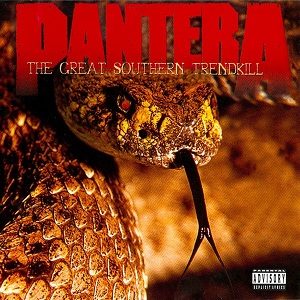
The Great Southern Trendkill
By Pantera
The Story
Released on May 7, 1996, The Great Southern Trendkill marked one of the most intense and divisive albums in Pantera’s catalog. Following the success of Far Beyond Driven, the band pushed their sound further into aggressive and darker territory. The recording process reflected internal strain, with vocalist Phil Anselmo recording many of his vocal parts separately from the rest of the band. This fragmented approach contributed to the album’s raw and confrontational tone.
Working with producer Terry Date, Pantera emphasized a dense and abrasive sound. Dimebag Darrell’s guitar tone remained heavy and textured, while Vinnie Paul’s drumming maintained precision within the chaotic arrangements. Rex Brown’s bass reinforced the low-end weight, supporting the album’s darker atmosphere. Compared to earlier releases, the songs often featured more abrupt transitions, layered textures, and a broader dynamic range.
The title track The Great Southern Trendkill opens the album with an immediate burst of intensity, combining rapid tempo with aggressive vocal delivery. War Nerve continues the confrontational tone with sharp rhythmic structure. Drag the Waters introduces a slower, groove-driven approach, while 10's provides a more melodic and restrained contrast.
13 Steps to Nowhere returns to a faster pace, leading into Suicide Note Pt. I, which begins with acoustic guitar and minimal arrangement before transitioning into the heavier Suicide Note Pt. II. This pairing highlights the album’s use of dynamic contrast. Living Through Me (Hell's Wrath) and Floods continue the mix of aggressive and atmospheric elements, with Floods featuring an extended instrumental section.
The Underground in America and (Reprise) Sandblasted Skin close the album with a raw and unpolished feel, emphasizing intensity over structure. The sequencing maintains a sense of tension throughout, with shifts between heavy and quieter sections.
The Great Southern Trendkill emphasizes aggression, fragmentation, and dynamic contrast. The album blends fast, abrasive passages with slower, atmospheric moments, creating a darker and more confrontational sound. With its raw production and varied structure, the record represents a more extreme phase in Pantera’s evolution and reflects the band’s willingness to push their sound beyond established expectations.