
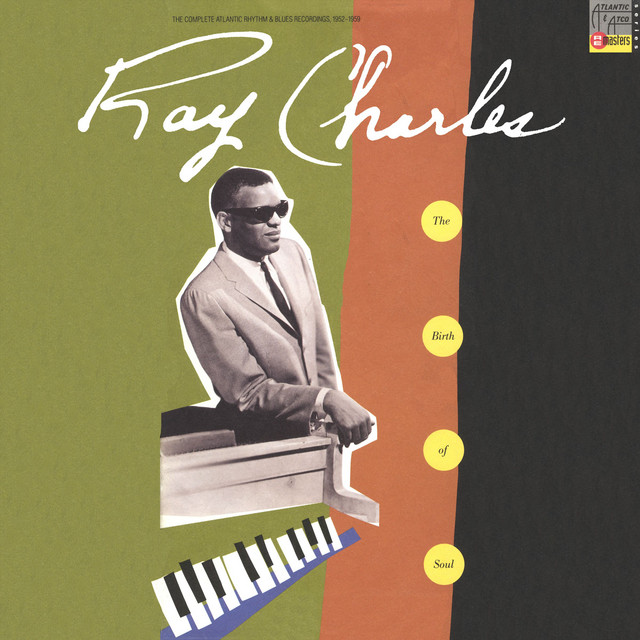
The Birth of Soul
By Ray Charles
The Story
The Birth of Soul: The Complete Atlantic Rhythm and Blues Recordings is not a traditional studio album but a three-disc compilation released in 1991 that documents the formative years of Ray Charles' career. Like James Brown, Ray Charles does not have a single definitive studio album that fully captures his importance. His influence was built through a sequence of groundbreaking singles recorded during the 1950s, and this collection serves as the most coherent way to understand his artistic evolution. Spanning recordings from 1952 to 1959, the compilation traces how Charles moved from traditional rhythm and blues into the creation of soul music, blending gospel, blues, and secular themes into a new and highly influential sound.
The first disc presents Ray Charles in his earliest Atlantic recordings, when he was still developing his identity. Tracks such as 'The Sun's Gonna Shine Again' and 'Roll With My Baby' show a strong connection to blues and jump rhythm and blues traditions, with vocal phrasing influenced by artists like Nat King Cole and Charles Brown. During this period, Charles was working within established musical conventions, but even in these recordings, there are signs of his emerging individuality, particularly in his phrasing and rhythmic approach. Songs like 'Mess Around' and 'Sinner's Prayer' hint at a growing emphasis on groove and emotional intensity that would soon become central to his work.
The second disc captures the breakthrough moment where Ray Charles effectively created the foundation of soul music. 'I Got a Woman' is widely regarded as a turning point, combining gospel-inspired melodies with secular lyrics, something that was controversial at the time but ultimately transformative. This fusion became a defining characteristic of his sound. Songs such as 'Drown in My Own Tears', 'Hallelujah, I Love Her So', and 'Lonely Avenue' demonstrate his ability to blend deep emotional expression with strong rhythmic structures. Albums from this era, including Ray Charles (1957) and The Great Ray Charles (1957), reflect his growing confidence and the establishment of a new musical language.
The third disc documents the late 1950s, when Charles refined and expanded his style into something more dynamic and influential. Tracks like '(Night Time Is) The Right Time' and 'What'd I Say (Parts 1 & 2)' highlight a more rhythm-driven approach, with call-and-response vocals and extended grooves that would shape the future of rhythm and blues, soul, and rock music. 'What'd I Say' in particular stands as one of his most important recordings, emerging from live performance improvisation and becoming a major commercial success. It marked the moment when Charles' fusion of gospel energy and secular themes reached a wide audience.
What distinguishes Ray Charles from many of his contemporaries is that his most important work during this period was released as singles rather than as cohesive albums. Because of this, a compilation like The Birth of Soul is essential for understanding his contribution. It allows listeners to follow his development chronologically, hearing how he moved from traditional forms into a groundbreaking synthesis that redefined popular music.
The recordings in this collection also reflect Charles' broader impact beyond music. His willingness to merge sacred and secular elements challenged cultural boundaries and influenced generations of artists across multiple genres. His approach to rhythm, vocal expression, and arrangement became foundational for soul music and had a lasting influence on rock, funk, and later styles.
In this context, The Birth of Soul functions as a historical narrative rather than a single artistic statement. It brings together key recordings from across Ray Charles' early career, illustrating how his innovations shaped the direction of modern music. For an artist whose legacy is defined by evolution rather than a single release, this compilation stands as the most complete and accessible representation of his work during a crucial period of transformation.