
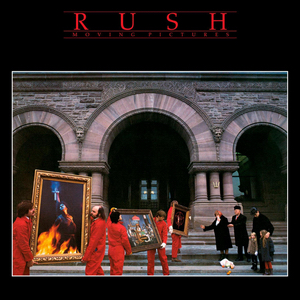
Moving Pictures
By Rush
The Story
Moving Pictures is the Rush album where the band's progressive ambition and commercial focus met at exactly the right moment. Released in 1981, it was the Canadian trio's eighth studio album and the follow-up to Permanent Waves, the record that had already shown them tightening their long-form progressive rock into shorter, more direct songs. With Geddy Lee, Alex Lifeson, and Neil Peart working again with longtime producer Terry Brown, Moving Pictures kept Rush's technical identity intact while giving the music a sharper, cleaner, and more accessible shape.
The album was written after the band chose to postpone plans for another live record and return to the studio while new ideas were still developing. Rush worked on material at Stony Lake in Ontario before recording at Le Studio in Morin-Heights, Quebec, during October and November 1980. The setting mattered: Le Studio gave the band space, isolation, and high-end recording facilities, helping them build a record that sounded both natural and precise. The album also came at a technological turning point for Rush, with synthesizers becoming more integrated into the songs rather than used only as decoration.
'Tom Sawyer' opens the album with one of the band's most recognizable statements. Its lyrics grew partly from words by Pye Dubois, a lyricist associated with Max Webster, and Neil Peart reshaped them into a portrait of individualism and guarded independence. Musically, the song combines a huge synthesizer presence, tight ensemble playing, and one of Peart's most famous drum performances. It became a signature Rush song because it managed to sound complex and immediately memorable at the same time.
The rest of the first side shows the album's range. 'Red Barchetta', inspired by Richard S. Foster's short story 'A Nice Morning Drive', turns a futuristic tale of forbidden driving into one of Rush's most vivid narrative songs. 'YYZ' is an instrumental named after the airport code for Toronto Pearson International Airport, with its opening rhythm based on the Morse code pattern of the letters Y-Y-Z. The track became one of the band's defining instrumental showcases and was nominated for a Grammy Award. 'Limelight' looked directly at the pressures of fame, especially Neil Peart's discomfort with celebrity and public attention, turning personal unease into one of the album's most enduring songs.
The second side is broader and darker. 'The Camera Eye' is the album's longest track and the last extended epic of Rush's classic progressive-rock period, contrasting impressions of New York and London. 'Witch Hunt', subtitled as part of the band's larger 'Fear' series, builds a grim atmosphere around suspicion, mob thinking, and moral panic. 'Vital Signs' closes the album by pointing toward the more reggae- and new wave-influenced textures Rush would explore further in the 1980s.
Moving Pictures became Rush's most commercially successful album, reaching number one in Canada and number three in both the United States and the United Kingdom. Its lasting power comes from balance. It is intricate without feeling overloaded, polished without losing force, and accessible without surrendering the band's intelligence or musicianship. For many listeners, it remains the clearest gateway into Rush: a record where virtuosity, storytelling, technology, rhythm, and memorable songwriting all move together.