
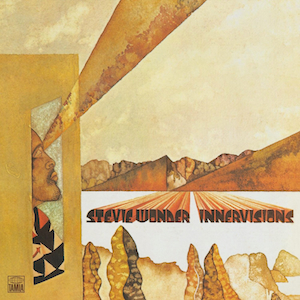
Innervisions
By Stevie Wonder
The Story
Innervisions arrived in 1973 during Stevie Wonder's extraordinary period of artistic freedom at Motown. After Music of My Mind and Talking Book, Wonder had already moved far beyond the image of the child prodigy known as Little Stevie Wonder. With Innervisions, he made one of his most complete statements as a songwriter, singer, multi-instrumentalist, producer, and social observer. The album was released on Tamla and was produced by Wonder with Malcolm Cecil and Robert Margouleff, whose work with synthesizers helped shape the record's unusually vivid sound world.
The album's title is important because Innervisions feels like both an inward and outward record. Wonder looks at addiction, racism, poverty, spiritual confusion, political corruption, romantic pain, and hope, but he does not treat those subjects as separate from the sound. The music itself seems to search for new colors. Wonder continued to use synthesizers not as novelty effects but as expressive instruments, especially through the T.O.N.T.O. system associated with Cecil and Margouleff. The result was soul music with a futuristic texture: warm, human, melodic, and electronic at the same time.
'Too High' opens the album with a warning about drug use, setting a serious tone without sacrificing groove or musical sophistication. 'Living for the City' is one of Wonder's most powerful narrative songs, following a Black family from Mississippi into a harsh urban reality and using spoken dramatic scenes to make the song feel almost cinematic. 'Higher Ground' turns spiritual rebirth and moral persistence into a tight clavinet-driven funk track, while 'Jesus Children of America' questions empty religious performance and false certainty.
The album is not only social commentary. 'Golden Lady' and 'All in Love Is Fair' show Wonder's gift for romantic writing, with the latter becoming one of his most enduring ballads. 'Don't You Worry 'bout a Thing' brings Latin influence, humor, and reassurance into the album's second half, while 'He's Misstra Know-It-All' closes the record with a pointed portrait of manipulation and corruption, widely heard as part of Wonder's broader critique of power and dishonesty in the early 1970s.
Innervisions became one of the defining albums of Wonder's classic run. It reached the upper ranks of the US album chart, produced major songs including 'Higher Ground', 'Living for the City', and 'Don't You Worry 'bout a Thing', and won Album of the Year at the Grammy Awards. Its lasting power comes from the way it balances conscience and beauty. Wonder made a record that is politically alert, spiritually searching, technologically adventurous, and deeply melodic. More than a collection of songs, Innervisions feels like a complete vision of the world as Wonder saw it in 1973: wounded, unjust, funny, loving, dangerous, and still capable of transformation.