
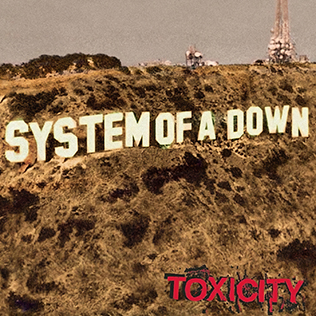
Toxicity
By System of a Down

The Story
Toxicity marked the breakthrough that established System of a Down as one of the most distinctive and unpredictable bands in early 2000s heavy music. Released in 2001 and produced by Rick Rubin alongside guitarist Daron Malakian and vocalist Serj Tankian, the album expanded significantly on the band's 1998 debut by refining their sound while pushing their stylistic extremes even further. Combining elements of metal, punk, alternative rock, and Armenian musical influences, the record stood out for its abrupt shifts in tempo, unconventional song structures, and a balance between aggression and melody.
Lyrically, the album is defined by its sharp political and social commentary. 'Prison Song' opens the record with a direct critique of mass incarceration and drug policy in the United States, immediately establishing the band's willingness to address controversial topics. Throughout the album, themes of control, media influence, environmental concerns, and societal dysfunction appear in different forms. 'Deer Dance' reflects on police violence and protest culture, while 'ATWA' references environmental ideas associated with Charles Manson's ideology, highlighting the band's tendency to explore unsettling subject matter from multiple angles rather than offering simple conclusions.
At the same time, Toxicity balances its intensity with moments of accessibility and emotional depth. 'Chop Suey!' became the album's most recognizable track, known for its dramatic dynamic shifts and cryptic yet widely interpreted lyrics. Despite its unconventional structure, it achieved significant mainstream success and became a defining song of the era. The title track 'Toxicity' further demonstrated the band's ability to combine heavy instrumentation with a strong melodic core, while 'Aerials' offered a more atmospheric and introspective closing statement that broadened their appeal.
Musically, the album showcases the interplay between Malakian's angular guitar work, Tankian's wide vocal range, and the rhythm section's ability to navigate sudden changes in pace and mood. Songs like 'Needles' and 'Bounce' emphasize frenetic energy and brevity, while 'Forest' and 'Science' explore more layered arrangements. This contrast contributes to the album's sense of unpredictability, where shifts between chaos and control become a central feature of its identity.
The release of Toxicity coincided with a turbulent moment in global events, and its themes of instability and critique gained additional resonance in that context. Despite this, or perhaps partly because of it, the album achieved major commercial success, reaching the top of the charts in the United States. It solidified System of a Down's reputation as a band capable of combining political engagement with musical innovation.
Toxicity remains a defining work in the band's catalog and in the broader landscape of early 2000s rock and metal. Its willingness to challenge expectations, both lyrically and musically, helped it stand apart from its contemporaries. By merging intensity with melody and commentary with experimentation, System of a Down created an album that continues to resonate as both a product of its time and a lasting statement of artistic identity.