
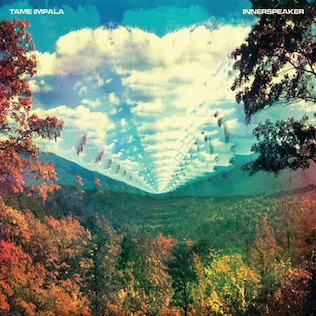
Innerspeaker
By Tame Impala
The Story
Innerspeaker was the moment Kevin Parker turned Tame Impala from a promising Australian psychedelic act into a fully realized album project with a distinct identity. Although Tame Impala toured as a band, Parker has consistently described the recording side of the project as essentially his own work, and that approach defines the record. After earlier releases like the self-titled EP and the single Sundown Syndrome, he began making an album that would preserve songs as vivid internal visions rather than as the product of a conventional band jamming process. Even the title reflected that idea: Parker used Innerspeaker to describe the feeling of hearing a song clearly in your mind before it exists in the world.
Most of the album was recorded in 2009 at Wave House in Injidup, Western Australia, a remote coastal property with dramatic ocean views and very few distractions. That isolation became part of the album’s identity. Parker recorded there with minimal outside interference, but the romantic setting came with real problems: the roof leaked, the power was unreliable, and he lost work during outages. Those difficulties did not erase the effect of the place itself. By Parker’s own account, the scenery and seclusion had a subconscious influence on the music, helping shape the album’s dreamy, immersive atmosphere.
In practical terms, Innerspeaker was a showcase for Parker’s obsessive home-recording mentality. He wrote nearly all of the material, played the vast majority of the instruments, and produced the album himself, with small contributions from Jay Watson and Dominic Simper. Tim Holmes of Death in Vegas was present during the sessions and later received Parker’s gratitude for helping steer parts of the recording process. When it came time to finish the album, Parker realized he could not achieve the explosive sound he wanted entirely on his own, so the recordings were sent to Dave Fridmann for mixing. Fridmann’s work helped give the album its thick, blurred, powerful character: guitars melt into drums, vocals float through the mix, and everything feels slightly weathered without losing scale.
The songs capture Parker at a stage when his love of classic psychedelic rock was obvious, but the album did not land simply as revivalism. Critics heard echoes of late-1960s guitar music, yet they also responded to how confidently Parker reorganized those influences into something personal. Solitude Is Bliss became one of the clearest windows into the record’s mindset, celebrating aloneness in a way that matched the circumstances of its creation. Jeremy’s Storm, the instrumental centerpiece, deepened the album’s sense of drift and momentum, while Runway, Houses, City, Clouds stretched outward into a long-form, heady finale before the closing comedown of I Don’t Really Mind.
There were other signs of Parker’s ambition behind the scenes. He originally imagined Innerspeaker as a double album, an idea he eventually abandoned because of the amount of work involved. That detail matters because it shows how expansive his thinking already was on a debut. Even in its final form, the record feels bigger than a first album usually does: not tentative, but fully committed to its own sonic world.
Released in May 2010, Innerspeaker quickly became a breakthrough. It was praised for bringing a modern energy to psychedelic rock, reached the top five on the ARIA Albums Chart, and won Australian Album of the Year at the J Awards. In retrospect, it stands as the opening statement of Parker’s larger career arc: a record built from solitude, technical curiosity, and a strong inner vision, but one that connected far beyond the room where it was made.