
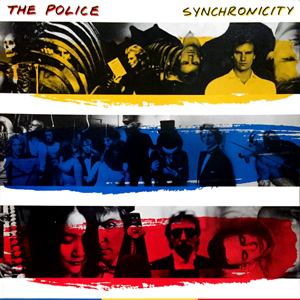
Synchronicity
By The Police
The Story
Synchronicity was the fifth and final studio album by The Police, released in 1983 at the peak of the band's commercial power and internal strain. After the success of Ghost in the Machine, Sting, Andy Summers, and Stewart Copeland reconvened for sessions that began at AIR Studios in Montserrat and continued at Le Studio in Quebec. The album was produced by the band with Hugh Padgham, whose work helped give the record its sharp, spacious, and highly detailed 1980s sound.
The title came from the idea of meaningful coincidence associated with Carl Jung, and the album's themes were also connected to Arthur Koestler's book The Roots of Coincidence. That intellectual frame gave the record a darker and more abstract mood than the band's early reggae-punk hits. The Police were still recognizable as a trio built on rhythmic precision and tension, but Synchronicity pushed them toward more atmospheric pop, art rock, and psychological drama.
The sessions were famously difficult. By this point, the relationship between Sting and Stewart Copeland had become especially tense, and accounts of the recording often describe the band as creatively powerful but personally fractured. That tension can be heard in the music. 'Synchronicity I' opens with nervous speed and conceptual urgency, while 'Walking in Your Footsteps' uses a sparse, almost ritual groove to connect human behavior with extinction. Andy Summers' 'Mother' and Copeland's 'Miss Gradenko' add odd, angular interruptions to Sting's more polished songwriting, making the first half of the album feel unstable by design.
The second side contains the songs that made Synchronicity a blockbuster. 'Every Breath You Take' became one of The Police's signature recordings, often mistaken for a love song despite its darker theme of surveillance and obsession. Its clean guitar figure, restrained arrangement, and Sting's controlled vocal made it one of the defining singles of the decade. 'King of Pain' turned private melancholy into vivid imagery, while 'Wrapped Around Your Finger' mixed mythic references with elegant, shadowy pop. 'Tea in the Sahara', inspired by a story within Paul Bowles' novel The Sheltering Sky, closed the original LP with a quiet, desert-like atmosphere rather than a triumphant finale.
Synchronicity became the band's biggest album, reaching number one in both the United Kingdom and the United States and producing major singles including 'Every Breath You Take', 'King of Pain', 'Wrapped Around Your Finger', and 'Synchronicity II'. It also won major Grammy recognition, with 'Every Breath You Take' earning Song of the Year. Yet its success also marked an ending. The Police toured behind the album, but they did not make another studio record together. Synchronicity endures because it captures both the brilliance and the breaking point of the band: three musicians turning conflict, control, anxiety, and pop craft into a final, highly polished statement.