
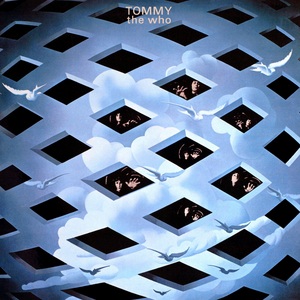
Tommy
By The Who
The Story
Tommy was the album that changed the scale of The Who's ambitions. Released in 1969, it was the band's fourth studio album and a double-LP rock opera, written mainly by Pete Townshend and produced by Kit Lambert. The group recorded it in London between September 1968 and March 1969, mostly at IBC Studios, during a period when Townshend was trying to move beyond the format of short mod-era singles and prove that rock music could sustain a long dramatic narrative.
The story follows Tommy Walker, a boy who becomes cut off from the outside world after a traumatic childhood event and later rises into a strange position of public fascination and spiritual authority. Townshend's concept was shaped in part by his interest in the teachings of Meher Baba, and the album translated ideas about perception, silence, suffering, illusion, and awakening into a theatrical rock structure. The plot was not always easy for listeners to follow from the record alone, but the emotional outline was clear: innocence, damage, exploitation, revelation, worship, and rejection.
Musically, Tommy widened The Who's language without abandoning their force. The album uses recurring themes and repeated musical ideas, giving it a sense of unity across its 24 tracks. 'Overture' introduces fragments that return later, while 'Amazing Journey' and 'Sparks' show the band's ability to move between narrative songcraft and instrumental power. John Entwistle contributed the dark character pieces 'Cousin Kevin' and 'Fiddle About', adding a disturbing edge to Tommy's story, while Keith Moon was credited with 'Tommy's Holiday Camp', a brief but memorable carnival-like moment near the end of the album.
'Pinball Wizard' became the album's most famous single and one of The Who's signature songs. Townshend reportedly wrote it partly to strengthen the album with a more direct rock song, and the pinball image gave Tommy's inner isolation a vivid public symbol: a boy who seems unreachable but becomes extraordinary through instinct and sensation. 'I'm Free' and the closing section of 'We're Not Gonna Take It', including the 'See Me, Feel Me' passage, carried the album's spiritual and communal themes into anthem form, helping the work translate powerfully to the stage.
Tommy was commercially and culturally decisive. It reached number two in the UK and became a major success in the United States, helping move The Who from a brilliant singles band into the front rank of album-era rock. Its live performances, including the band's late-1960s and early-1970s concerts, made the material even more powerful and helped build the group's reputation as one of rock's most explosive stage acts. The album later inspired film, theatre, and orchestral adaptations, but the original 1969 recording remains the central statement: ambitious, uneven in places, sometimes unsettling, but bold enough to expand what a rock album could attempt.