
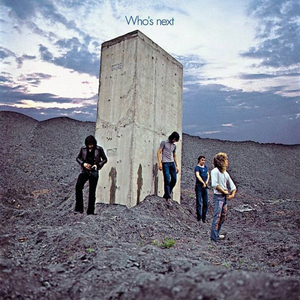
Who's Next
By The Who
The Story
Who's Next began as the remains of one of Pete Townshend's most ambitious ideas. After the success of Tommy, Townshend conceived Lifehouse, a large multimedia rock-opera project involving a dystopian future, audience participation, spiritual ideas about music, and new technology. The concept became too difficult to realize in its original form, and tensions around the project left The Who needing a more practical path forward. Instead of completing Lifehouse as planned, the band reshaped some of its strongest songs into a single studio album.
Recorded mainly in 1971 at Olympic Studios in London, with important work also done at Stargroves using the Rolling Stones Mobile Studio, Who's Next captured The Who at a rare balance point: powerful enough to sound like one of the greatest live rock bands in the world, but focused enough to turn that force into precise studio recordings. Glyn Johns played an important role in helping the group move away from the overloaded Lifehouse concept and toward a direct album built from the best available material. The result was not a conventional concept album, but it still carried traces of Townshend's original vision: technology, isolation, mass emotion, spiritual searching, and suspicion of false revolution.
The album's opening immediately made that new language clear. 'Baba O'Riley' used a repeating electronic pattern, inspired by Townshend's experiments with synthesizers and sequencing, before exploding into one of Roger Daltrey's most commanding vocal performances. Dave Arbus of East of Eden added the violin part that drives the song's final section into folk-like frenzy. 'Bargain' turned spiritual surrender into muscular rock, while 'Love Ain't for Keeping' showed the band's lighter acoustic side. John Entwistle's 'My Wife' brought a darker comic edge, using a frantic domestic scenario and brass overdubs to give the album one of its most distinctive contrasts.
The second half deepened the record's emotional range. 'The Song Is Over' and 'Getting in Tune' preserved the reflective side of Lifehouse, presenting music itself as a source of connection and meaning. 'Going Mobile' captured Townshend's fascination with freedom and escape, while 'Behind Blue Eyes' became one of The Who's most famous character studies, moving from quiet confession to explosive release. The closing 'Won't Get Fooled Again' turned political disillusionment into a monumental rock anthem. Its synthesizer pattern, taken from Townshend's demo work, helped make the track sound futuristic without weakening the band's physical impact.
Who's Next became one of The Who's most acclaimed albums and their only album to reach number one on the UK Albums Chart. It also produced some of their most enduring songs, with 'Baba O'Riley', 'Behind Blue Eyes', and 'Won't Get Fooled Again' becoming central to the band's legacy. What makes the album remarkable is that it came from a failed grand design but did not feel like a compromise. Lifehouse may have collapsed as a project, but Who's Next turned its strongest ideas into a tighter, more powerful form: a rock album about faith, frustration, escape, and the search for connection in a modern world.