Lateralus
By Tool
The Story
Lateralus was the album where Tool turned the breakthrough of Aenima into something even more expansive, patient, and architecturally complex. Released in 2001 through Volcano Entertainment, it was the band's third studio album and their second with bassist Justin Chancellor. The record was produced by Tool and David Bottrill, who had also worked with them on Undertow and Aenima, and it was recorded between late 2000 and early 2001 in several Los Angeles-area studios.
Coming after a long gap between studio albums, Lateralus sounded like a band deliberately refusing to make a simple follow-up. Instead of chasing shorter alternative-metal singles, Tool built a nearly 79-minute album around long forms, shifting rhythms, spiritual and psychological imagery, and a greater sense of space. Maynard James Keenan's vocals often feel less like a conventional frontman performance and more like a voice moving through the band's machinery, while Adam Jones, Justin Chancellor, and Danny Carey create patterns that slowly tighten, collapse, and open again.
The album's central themes are transformation, patience, communication, and the difficult work of moving beyond resentment or limitation. 'The Grudge' opens the record with a heavy meditation on letting go of anger, setting up the album's interest in emotional and spiritual discipline. 'The Patient' turns endurance into a kind of moral test, while 'Schism' frames broken communication through one of Tool's most recognizable bass lines. 'Schism' became the album's major single and won the Grammy Award for Best Metal Performance, giving the band one of its clearest moments of mainstream recognition without softening its sound.
The linked sequence of 'Parabol' and 'Parabola' became one of Lateralus' clearest statements of contrast. The first part is quiet, almost devotional, while the second erupts into a celebration of physical existence and presence. The title track is the album's most famous example of Tool's interest in mathematical and symbolic structure. Its vocal phrasing and rhythmic design are widely associated with the Fibonacci sequence, and the song's shifting meters and rising intensity turn that idea into a musical image of growth, expansion, and pushing beyond fixed boundaries.
Lateralus also makes room for atmosphere and unease. Shorter pieces such as 'Eon Blue Apocalypse' and 'Mantra' act as transitions rather than standalone rock songs, while the closing 'Faaip de Oiad' uses a disturbing sampled radio-call fragment to end the album in a state of paranoia and unresolved tension. The long late-album stretch of 'Disposition', 'Reflection', and 'Triad' shows the record at its most hypnotic, moving from quiet reflection into a heavy instrumental build that feels ritualistic rather than simply aggressive.
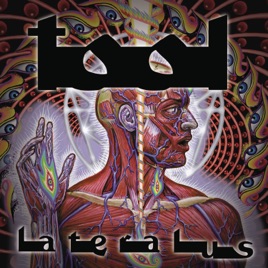
The visual world of Lateralus was also central to its identity. Artist Alex Grey created the album's layered anatomical and spiritual imagery, matching the record's interest in the body, consciousness, and transformation. The packaging helped make the album feel like an object to be explored, not only a set of songs to be played.
Lateralus debuted at number one on the Billboard 200 and became one of Tool's defining releases. Its importance lies in how fully it committed to complexity without losing emotional force. It is heavy, but not only because of distortion or volume. Its weight comes from repetition, tension, patience, symbolic detail, and the sense that every part of the music is slowly pulling the listener toward some difficult form of release.