
Eagles of Death Metal
Biography
Eagles Of Death Metal began as one of the least literal names in modern rock. The group was formed in Palm Desert, California, in 1998 by Jesse Hughes and Joshua Homme, old friends from the desert music orbit connected to Kyuss, Queens Of The Stone Age, the Desert Sessions, Mondo Generator, and a loose community of musicians who treated recording as part party, part experiment, and part private joke. The name was designed to confuse. Eagles Of Death Metal were not death metal, and they were not a literal tribute to the Eagles. The band has offered more than one version of the name's origin, but each version turns on the same joke: imagining a slick, boogie-friendly version of something supposedly extreme. That mismatch became the band's whole point: heavy rock energy stripped of solemnity, desert-rock muscle made loose enough to dance to, and a frontman persona closer to a nightclub preacher than to a brooding hard-rock singer.
The center of the band has always been the unusual division of labor between Hughes and Homme. Homme was already becoming known as the architect of Queens Of The Stone Age, a guitarist, songwriter, producer, and organizer with a gift for dry grooves and hard edges. In Eagles Of Death Metal, he mostly moved behind the drum kit, arranged songs, produced records, sang harmonies, and let Hughes stand in the lights. Hughes, also known as 'The Devil' and later 'Boots Electric', became the voice and face of the project: mustached, theatrical, teasing, often outrageous, and deeply invested in the old idea that rock and roll should be physical, funny, and a little ridiculous. Homme's fame sometimes made people call the group a side project, but the records make clear that EODM is Hughes' world as much as Homme's. Homme gives it shape and impact; Hughes gives it personality.
Before the debut album, recordings tied to the project appeared in embryonic form on 'The Desert Sessions Volumes 3 & 4' in 1998. Hughes played on those sessions, but by his own later accounts he had not set out to become a professional rock musician. He returned to ordinary work and family life, including jobs as a journalist and speechwriter. One of the most important early stories of the band came several years later, around 2003, when Hughes was going through a difficult divorce and custody situation. He began writing very simple songs to entertain his young son. Homme heard one of them, 'I Only Want You', and encouraged him to write more in that vein. That anecdote matters because it explains why the band's most flamboyant music often has a child's directness underneath it: short riffs, simple titles, repeated hooks, and choruses that feel less composed than blurted out with glee.
Their first full-length album, 'Peace, Love, Death Metal', arrived on March 23, 2004, on AntAcidAudio. It was produced by Homme and recorded primarily by Hughes and Homme, with contributions from musicians including Tim Vanhamel, Brody Dalle, Nick Oliveri, Alain Johannes, Natasha Shneider, and others. The credits leaned into the joke, listing Hughes under names such as 'J. Devil Huge' and 'Mr. Boogie Man', while Homme appeared under aliases including 'Carlo von Sexron' and 'Baby Duck'. But the music was not just a gag. 'Peace, Love, Death Metal' took the compact force of garage rock, the hip-swing of early rock and roll, the desert-scene love of repetition, and the cartoon leer of glam and rockabilly, then reduced everything to its most immediate parts. 'I Only Want You' and 'Speaking in Tongues' were built around blunt guitar figures and Hughes' falsetto yelps, while 'Miss Alissa' showed how easily the band could make a small riff feel like a private invitation to move.
What made the debut distinctive was not technical novelty but attitude and proportion. Eagles Of Death Metal avoided the heavy, monolithic drag that listeners might have expected from a Homme-related project. Instead of the ominous pressure of Queens Of The Stone Age, the songs moved with handclaps, swaggering drums, dirty little blues shapes, and a sense of comic timing. The band sounded as if they had raided the same record collection as a thousand garage groups - the Rolling Stones, the Cramps, boogie rock, old rhythm and blues, and cheap glam - but they turned those materials into something unusually lean. There was no attempt to hide the influences. The charm was in how shamelessly the band embraced them, then replaced reverence with mischief.
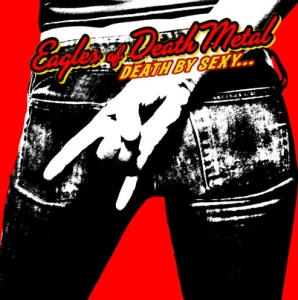
The second album, 'Death By Sexy', released in the United States on April 11, 2006, proved that the debut had not been a one-record joke. Hughes and Homme reconvened for a record that was completed quickly, with contemporary profiles noting that it was recorded in eight days. The guest list showed how connected the band was to the wider Homme universe and beyond: Jack Black, Brody Dalle, Mark Lanegan, Joey Castillo, Dave Catching, Brian O'Connor, Troy Van Leeuwen, Liam Lynch, and others appear in the album's personnel. The songs are more focused than the debut without becoming polished in a conventional sense. 'I Want You So Hard', 'Cherry Cola', 'I Like to Move in the Night', 'Don't Speak', and 'Chase the Devil' sharpened the formula into tight, punchy bursts. Homme's drumming was crucial: not flashy, but heavy in the pocket, built around stomp, snare, and momentum. Hughes sang as if he were both fronting a garage band and hosting a late-night variety show.
The period around 'Death By Sexy' also gave the band one of its most famous and very EODM-like public episodes. In 2006 they were booked to open for Guns N' Roses, but the support slot lasted only one show after Axl Rose mocked them from the stage with the nickname 'Pigeons of Shit Metal'. Rather than bury the insult, the band later folded it back into its own mythology, using the phrase for a covers release. That moment says a lot about Eagles Of Death Metal's strange position: too silly for some hard-rock purists, too loud and vulgar for some indie audiences, yet tough enough to turn humiliation into branding. They were a band built to survive being misunderstood because misunderstanding was baked into the name.
'Heart On', released on October 28, 2008, was the point where EODM sounded most like a fully realized band rather than a brilliant prank with great timing. It was again produced by Homme, with Hughes and Homme joined by players and singers such as Dave Catching, Brian O'Connor, Troy Van Leeuwen, Alain Johannes, Tony Bevilacqua, Brody Dalle, Kat Von D, and others. The album was more polished and broader in mood. 'Anything 'Cept the Truth' opened with big, strutting force, while 'Wannabe in L.A.' turned Hughes' fascination with California pose and performance into one of the band's most memorable singles. The Liam Lynch-directed video used a pin-art visual gag, a perfect image for a singer who understood himself as both frontman and cartoon figure.
The deeper value of 'Heart On' is that it allowed some vulnerability to creep through the grin. 'Now I'm a Fool' and 'How Can a Man With So Many Friends Feel So Alone' did not abandon the band's love of riffs, puns, and swagger, but they suggested that Hughes and Homme could bend their boogie-rock machinery toward melancholy without killing the party. The production was thicker than before: guitars had more bite, basslines had more definition, and the songs showed a stronger sense of pop architecture. If 'Peace, Love, Death Metal' sounded like a roomful of friends laughing while the tape rolled, and 'Death By Sexy' sounded like a quick, confident mission, 'Heart On' sounded like the band discovering how large its small idea could become.
After touring behind 'Heart On', Eagles Of Death Metal slowed down. Homme's calendar filled with Queens Of The Stone Age and Them Crooked Vultures, while Hughes released a solo album as Boots Electric, 'Honkey Kong', in 2011. During that stretch, the band's identity became clearer by absence. EODM was not a machine built for constant output. It worked best when Hughes and Homme returned to the same private chemistry: two friends speaking in a shared comic language of aliases, innuendo, old riffs, and desert-scene loyalty. Hughes also became an ordained minister with the Universal One Church in 2012, a fact that fit his public image oddly well. He often seemed to combine rock frontman, carnival barker, and revival preacher, not in a tidy spiritual way, but as a theatrical bundle of appetite, showmanship, and confession.
The fourth studio album, 'Zipper Down', appeared on October 2, 2015, after a seven-year gap. Released through T-Boy and UMe, it was again produced by Homme, with technical work including Homme's engineering, Mark Rankin's mixing at Pink Duck Studios, and Gavin Lurssen's mastering. Compared with the guest-filled earlier records, 'Zipper Down' leaned more strongly into the Hughes-Homme core, though Tuesday Cross and Matt Sweeney contributed to the sessions. Several songs, including 'Complexity', 'I Love You All the Time', and 'Oh Girl', had appeared in different form on Hughes' Boots Electric album 'Honkey Kong', and their reworking gave the album a strange dual identity: part new EODM record, part reshaped personal songbook. The Duran Duran cover 'Save a Prayer' was an unexpected turn, replacing sleek 1980s atmosphere with a loose glam-rock sway and showing that the band could make even a pop classic sound as if it had wandered into a desert bar after midnight.
Musically, 'Zipper Down' did not try to reinvent the band. It doubled down on what EODM did best: clipped guitar figures, handclap-ready rhythms, short running times, double meanings, and the feeling that every song should be able to work onstage before anyone has time to overthink it. 'Silverlake' poked fun at fashionable Los Angeles social climbing, 'Got a Woman' returned to the band's twitchy boogie reflexes, and 'The Reverend' folded Hughes' religious self-image back into the mission of making people dance. The album arrived alongside 'The Redemption of the Devil', a Vice documentary focused on a turbulent period in Hughes' life, and it caught the band at a moment when their comedy, bravado, and darker self-awareness were unusually close together.
One month after 'Zipper Down' came the event that permanently changed how many people heard the band's name. On November 13, 2015, Eagles Of Death Metal were performing at the Bataclan in Paris during the coordinated terrorist attacks across the city. The Paris attacks killed 130 people in total; 89 were killed at the Bataclan. The band members survived, but their merchandise manager Nick Alexander and three colleagues from their record label, Thomas Ayad, Marie Mosser, and Manu Perez, were among those killed. Any biography of the band has to mention this, but it also has to be careful not to let the attackers define the group. Eagles Of Death Metal existed before that night as a band devoted to release, humor, bodies in motion, and audience connection. The horror of the attack landed precisely because it struck a space built for the opposite: a room where strangers had gathered to enjoy loud, unserious, communal rock and roll.
The aftermath was painful, complicated, and public. The band canceled the rest of the European tour, then returned to the stage in Paris on December 7, 2015, appearing with U2 at AccorHotels Arena. U2 and EODM performed Patti Smith's 'People Have the Power', and then Eagles Of Death Metal played 'I Love You All the Time'. Soon afterward, the band encouraged other artists to cover 'I Love You All the Time' through the 'Play It Forward' campaign, with proceeds directed through the Sweet Stuff Foundation to aid victims and families affected by the attack. Florence and the Machine, My Morning Jacket, Kings of Leon, Jimmy Eat World, Savages, and others took part. The song, once simply one of the lighter pieces on 'Zipper Down', became attached to solidarity and remembrance in a way no one could have planned.
The band resumed European dates under the name 'Nos Amis Tour', meaning 'Our Friends Tour', and played the Olympia in Paris on February 16, 2016, with Bataclan ticket holders offered free admission. That return was later captured on 'I Love You All the Time: Live at the Olympia in Paris', released in 2017, and the broader story was explored in Colin Hanks' HBO documentary 'Eagles of Death Metal: Nos Amis (Our Friends)'. The documentary placed the friendship between Hughes and Homme at the emotional center of the story, because that bond had always been the band's engine. After the attack, it also became one of the ways the band processed survival, grief, responsibility, and the decision to continue.
Hughes' public persona also brought controversy. In 2016 he made widely criticized claims about Bataclan security, then apologized after backlash from French officials, the venue, and others. Some festival cancellations followed, and the episode damaged his reputation with many listeners. It is part of the band's story because Eagles Of Death Metal were never a neutral or carefully managed act. Hughes' charisma, impulsiveness, politics, religiosity, humor, and appetite for provocation are all tangled together in the public record. At his best, that mixture made him a magnetic rock and roll frontman. At its worst, it made him a source of avoidable hurt and controversy. A truthful biography has to hold both realities at once.
After 'Zipper Down', EODM's original studio output slowed again, but the band continued to release projects that reflected its love of other people's songs. In 2018 they issued the vinyl-only covers album 'Pigeons of Shit Metal', turning the old Axl Rose insult into a title and covering artists including Guns N' Roses, AC/DC, the Ramones, the Pixies, Love and Rockets, the Distillers, Queens Of The Stone Age, and the Steve Miller Band. In 2019 came 'EODM Presents Boots Electric Performing the Best Songs We Never Wrote', a wider covers collection featuring material associated with artists such as Mary J. Blige, David Bowie, George Michael, Kenny Rogers, and others. The selections made sense for a band whose whole style had always been about translation: take a familiar shape, remove the polish, add hips, fuzz, falsetto, and absurd confidence, and make it feel like EODM.
The band's later releases also show how much Eagles Of Death Metal is tied to Hughes' alter ego as much as to a conventional band structure. 'A Boots Electric Christmas', released in 2021, recast holiday songs through the same mischievous lens, with Homme appearing on an a cappella version of 'O Holy Night'. On paper, Christmas music might seem far from the world of 'Death By Sexy', but the through-line is performance. Hughes treats genre as costume, ceremony, and invitation. Whether he is singing a garage-rock come-on, a Duran Duran cover, a George Michael melody, or a seasonal standard, the goal is rarely purity. It is transformation through character.
Eagles Of Death Metal matter because they occupy a peculiar corner of modern rock. They are connected to one of the most respected heavy-rock lineages of the last three decades, but their own music refuses heavy-rock seriousness. They borrowed from garage rock, blues, glam, rockabilly, disco pulse, and desert-rock repetition, yet avoided becoming a retro museum piece by turning everything into a running act of personality. Homme's production and drumming gave the songs discipline; Hughes' frontman energy gave them risk. The result is music that can seem simple until one notices how precisely it is built: the clipped riffs, the dry spaces, the falsetto hooks, the backing shouts, the grooves that leave room for bodies rather than filling every corner with distortion.
Their legacy is inseparable from contradiction. They began as a joke and became a real band. They made unserious music with serious craft. They were often filed under Josh Homme's side projects, yet their records are dominated by Jesse Hughes' voice, taste, humor, and volatility. They built songs out of borrowed rock gestures but made those gestures unmistakably theirs. They survived one of the darkest nights in modern concert history and continued playing, while also carrying the scars, disputes, and public consequences that followed. At their strongest, Eagles Of Death Metal are a reminder that rock and roll does not always need grandeur to feel alive. Sometimes it needs a cheap riff, a wicked grin, a drummer who understands the floor, and a singer who treats the crowd like a congregation invited to dance.