
Rage Against the Machine
Biography
Rage Against the Machine began as a collision that almost should not have worked: a Harvard-educated guitarist with a deep love of metal riffs, hip-hop rhythm, and radical politics; a vocalist raised between punk shows, Chicano activism, and Southern California hardcore; a rhythm section that could make protest music move like funk and hit like heavy machinery. Formed in Los Angeles in 1991, the band brought together Zack de la Rocha, Tom Morello, Tim Commerford, and Brad Wilk, four musicians whose chemistry made them sound complete almost immediately. They were not the first rock band to use political anger, and they were not the first to mix rap and guitars, but they found a language so direct and physical that it felt less like a crossover experiment than a new kind of public alarm.
De la Rocha came into the group from the hardcore underground. He had fronted Inside Out, a short-lived but intense band connected to the straight-edge punk scene, and he carried that world with him: clenched delivery, moral urgency, and lyrics shaped by systems of power rather than ordinary rock confession. Commerford, a childhood friend of de la Rocha, had a bass style that made Rage's music unusually elastic for a heavy band. Wilk had tried out for other groups before finding the right fit, but with Rage his drumming became the hinge between rock force and hip-hop space. Morello, who had played in the band Lock Up, was the group's most unusual instrumental voice. Rather than chase blues-rock heroics, he treated the guitar like a machine to be rewired. His riffs could be blunt and monolithic, but his solos often sounded like turntables, sirens, broken electronics, or something scraped from the side of a factory wall.
The band's name had a link to de la Rocha's earlier work with Inside Out, but it suited the new group almost too perfectly. Rage Against the Machine did not write political songs as decoration. The politics were part of the architecture. Their music drew from Public Enemy, Led Zeppelin, Black Sabbath, punk, funk, and West Coast hip-hop, yet the result was clean and severe: no second guitarist, no keyboards as a regular feature, very little studio gloss, and an almost militant reliance on the four players in a room. The early self-released cassette, also called 'Rage Against the Machine', already contained the core of the debut album. Its handmade cover, with a match attached to a collage-like image, matched the music's sense of imminent combustion. The demo circulated quickly, and the band signed with Epic, a major-label move that would follow them throughout their career as both opportunity and contradiction.
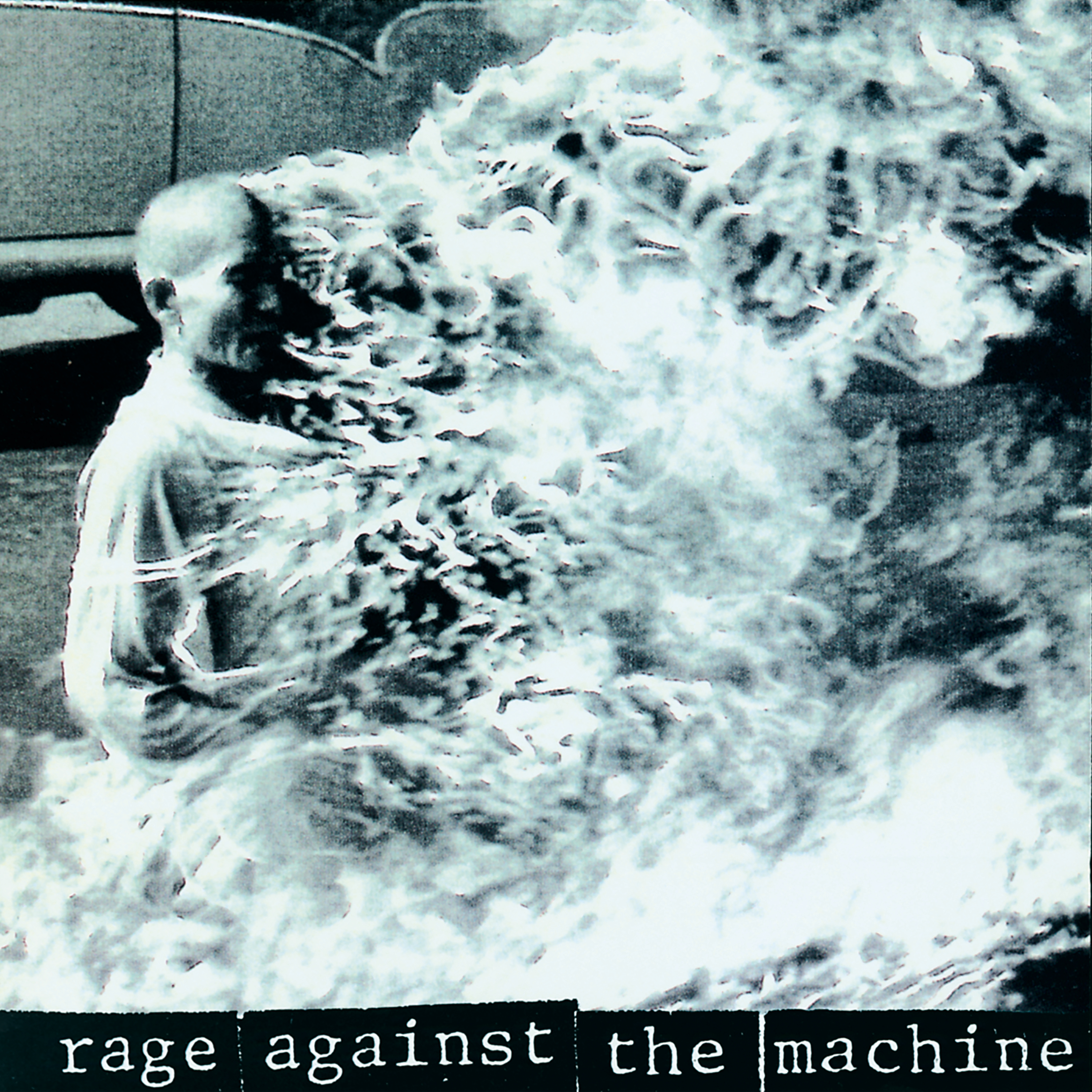
Their 1992 debut, 'Rage Against the Machine', remains one of the most startling first albums of its era because it arrived already fully formed. Produced by Garth Richardson, the record did not sound like a band searching for an identity. 'Bombtrack' opened with a bass figure that felt calm for only a few seconds before the full band snapped into place. 'Killing in the Name' turned a simple, grinding riff into a mass chant, building from restraint to refusal. 'Bullet in the Head' used space and repetition the way a great hip-hop track might, while 'Know Your Enemy' stretched into a wider, more progressive structure. The album's cover used Malcolm Browne's well-known 1963 protest photograph of Thich Quang Duc, a choice that signaled how seriously the band wanted the listener to take the record's themes of state violence, obedience, and resistance.
What made the debut powerful was not just volume or politics, but discipline. Morello's guitar sounds were often mistaken for samples, yet the band repeatedly emphasized that the strange textures came from guitar, pedals, switches, and technique rather than synthesizers. Wilk and Commerford rarely overplayed. They left enough room for de la Rocha's words to land. The vocals did not move with the relaxed swing of party rap or the theatricality of metal singing; they came in bursts, like testimony shouted over a barricade. The record sold gradually at first, then became a fixture of alternative radio and MTV at a time when heavy music, hip-hop, and political disillusionment were all pushing into the mainstream.
Rage's rise was not smooth or polite. At Lollapalooza in 1993, the band used its stage time for a silent protest connected to censorship concerns rather than a conventional set, a move that confused some fans and fit the group's belief that performance could be confrontation. In 1996, while booked on 'Saturday Night Live', they clashed with the show's producers over American flags placed upside down on their amplifiers during rehearsal, a protest connected to that night's host, presidential candidate Steve Forbes. The flags were removed, and the band was allowed to perform only one song before being removed from the building. Incidents like that made Rage seem less like a rock act with opinions and more like a pressure point inside popular culture, constantly testing how much dissent the entertainment machine could tolerate.
The second album, 'Evil Empire', arrived in 1996 after internal tension and delays. The title borrowed Ronald Reagan's Cold War phrase and turned it back toward American power. Produced by Brendan O'Brien, the album was leaner and in some ways stranger than the debut. It entered the Billboard 200 at number one, but it did not soften the band for a larger audience. 'Bulls on Parade' was built around one of Morello's most recognizable riffs and a solo that imitated turntable scratching without losing the physicality of guitar. 'People of the Sun' connected the Zapatista uprising and Indigenous resistance to the band's broader anti-imperial politics. 'Down Rodeo' moved with a cold, stalking groove, while 'Vietnow' attacked media manipulation through a lurching, unstable rhythm. The record showed that Rage could become commercially bigger without becoming less severe.
The friction inside the band mattered creatively. De la Rocha's political focus was uncompromising, and Morello, Commerford, and Wilk were equally committed to a hard, minimal group sound, but they did not always agree on direction. That tension helped keep the music from becoming comfortable. On 'Evil Empire', the band leaned even more into groove. The riffs were not just metal riffs with rap vocals placed over them; they were designed as loops, hooks, and pressure systems. Commerford's bass often functioned like a second lead instrument, giving tracks their swagger and threat. Wilk's drums made the songs breathe, especially when the guitars dropped out and de la Rocha's voice carried the momentum alone.
By the time of 'The Battle of Los Angeles' in 1999, Rage Against the Machine were no longer a shocking new arrival. They were a major band with a global audience, and the question was whether their formula could still feel urgent. The album answered by sharpening everything. Produced again with Brendan O'Brien, it was tighter, more controlled, and in places more melodic than earlier records, without losing the band's basic force. 'Testify' opened with guitar sounds that seemed to stutter and spark before locking into a heavy riff. 'Guerrilla Radio' became one of the band's most visible songs, winning a Grammy and giving them a slogan that could fit both a protest march and an arena. 'Calm Like a Bomb' and 'Sleep Now in the Fire' showed how their writing could be both direct and musically inventive, using repetition not as laziness but as a way to build pressure.
The promotional period around 'The Battle of Los Angeles' produced one of the band's most memorable public spectacles. For the Michael Moore-directed video for 'Sleep Now in the Fire', Rage performed near the New York Stock Exchange, drawing a crowd and police attention as the shoot spilled into the surrounding area. The event fit the song's attack on greed and empire so neatly that it became part of the band's mythology: Rage taking its sound to the symbolic center of American finance, turning a music video into a public disruption. The album became another number one release and proved that the band could still command the mainstream without making peace with it.
Yet the group was coming apart. In October 2000, de la Rocha announced that he was leaving, saying the band's decision-making process had broken down. The timing was striking: Rage had reached a rare level where radical left politics, platinum sales, MTV exposure, and festival crowds existed in the same space, but the people inside the band could not sustain the partnership. Their final studio release of that first era, 'Renegades', came out later in 2000. A covers album produced by Rick Rubin, it revealed the band's roots by reworking songs associated with artists such as Afrika Bambaataa, Devo, Bob Dylan, the MC5, Cypress Hill, and Bruce Springsteen. Instead of treating covers as nostalgia, Rage used them like a map of rebellion across genres. Their version of 'How I Could Just Kill a Man' emphasized the hip-hop source material, while 'The Ghost of Tom Joad' connected Springsteen's Dust Bowl imagery to the band's own interest in labor, migration, and dispossession.
After de la Rocha's departure, Morello, Commerford, and Wilk formed Audioslave with Chris Cornell of Soundgarden. That band became successful in its own right, but it also showed how specific Rage's chemistry had been. Without de la Rocha, the instrumental trio could still produce enormous riffs and grooves, but the moral voltage changed. De la Rocha worked more quietly on solo material and collaborations, including music with DJ Shadow and later the project One Day as a Lion with drummer Jon Theodore. The long silence around a full solo album only added to his reputation as one of rock's more private and exacting figures.
Rage reunited in 2007, first for Coachella, where they appeared before a huge crowd with imagery connected to the Zapatista movement behind them. The reunion did not produce a new studio album, but it confirmed the durability of the songs. Unlike many reunions built mainly on nostalgia, Rage's material kept colliding with the present. Wars, surveillance, inequality, police violence, immigration battles, and corporate power had not disappeared; if anything, the band's catalog often sounded less dated than expected. The shows that followed in 2007 and 2008 reintroduced them as a live force, with de la Rocha pacing and exploding across the stage while the band held the music with almost mechanical precision.
One of the strangest later chapters in Rage's story came in the United Kingdom in 2009, when a grassroots online campaign pushed 'Killing in the Name' to Christmas number one as a protest against the dominance of television talent-show singles. The campaign was partly playful, but the result was real: a song built on refusal and profanity beat the expected pop-machine winner and became a public joke at the expense of manufactured consensus. Rage responded by supporting the spirit of the campaign and later playing a free concert in London in 2010. It was a reminder that the band's work could escape its original context and become a tool for listeners in their own arguments with authority, boredom, and cultural control.
The 2010s kept the members active in separate forms. Morello recorded protest-oriented folk-rock as the Nightwatchman and remained a highly visible activist-musician. Commerford pursued projects including Wakrat. Wilk played with other artists. In 2016, Morello, Commerford, and Wilk joined Chuck D of Public Enemy and B-Real of Cypress Hill in Prophets of Rage, a group that performed new material as well as songs from their members' catalogs during a volatile political period. Prophets of Rage underlined both the reach of Rage's sound and the absence of de la Rocha's particular voice. Many musicians can shout about injustice; far fewer sound as if every syllable has been sharpened against years of study, anger, and restraint.
A full Rage reunion was announced in 2019, with a tour planned for 2020 under the title 'Public Service Announcement'. The pandemic delayed those dates, and the band finally returned to the stage in 2022. Early in that tour, de la Rocha suffered a serious Achilles tendon injury, but he continued performing seated for a run of shows. The image of him delivering the songs without the usual physical motion became oddly powerful: the body restricted, the voice still burning. The remaining tour dates were eventually canceled, and in January 2024 Brad Wilk wrote publicly that Rage Against the Machine would not be touring or playing live again. The statement gave the band's long, stop-start history a hard ending, even if the music itself had always seemed built to resist endings.
In 2023, Rage Against the Machine were inducted into the Rock and Roll Hall of Fame. Only Morello attended the ceremony, which felt consistent with the band's complicated relationship to institutions. In his speech, he framed Rage less as a finished monument than as an invitation for others to act. That was always the central paradox of the band. They became famous inside the same commercial system they attacked, sold millions of records through a major label, won industry awards, and played corporate-sponsored festivals, yet their best songs did not feel absorbed by that machinery. The contradiction was real, but so was the impact.
Rage Against the Machine's influence can be heard across rap metal, nu metal, post-hardcore, alternative metal, protest rap, and politically charged rock, though many bands borrowed only the surface: the shouted vocals, the drop-tuned weight, the anger. What was harder to copy was the balance. Rage were heavy but not cluttered, political but not abstract, funky but not loose, intellectual but never bloodless. Morello's guitar gave them a vocabulary no other band possessed. Commerford and Wilk made the music dance even when it sounded like machinery. De la Rocha gave it conscience, history, and threat. Together they made protest music that could fill arenas without smoothing its edges.
Their catalog is small for a band of their stature: three original studio albums, one covers album, and a handful of live releases. That compactness is part of their power. There is very little drift in the discography, no long run of compromised records, no attempt to mature into polite respectability. From the first cassette to the final reunion, Rage Against the Machine sounded like a band built around a single unresolved argument: who holds power, who suffers under it, and what it means to refuse. Their songs did not provide easy answers, and they were never as simple as pure slogans. At their best, they turned rhythm, noise, and political memory into something that still feels dangerous in a crowd: thousands of people moving together, shouting back at the machine.