The Story
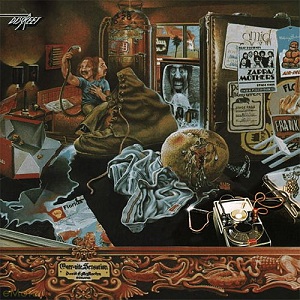
Over-Nite Sensation arrived on September 7, 1973, at a moment when Frank Zappa was reshaping both his band and his public image. After the large-scale jazz and big-band ambitions of Waka/Jawaka and The Grand Wazoo, he pulled together a new Mothers lineup built from unusually versatile players, including George Duke, Jean-Luc Ponty, Ruth Underwood, Ian Underwood, Tom Fowler, Bruce Fowler, Ralph Humphrey, and Sal Marquez. The result was a group capable of handling Zappa’s most intricate rhythmic and harmonic ideas while also locking into tighter, more song-driven material.
That balance is what makes the album so important in his catalog. Over-Nite Sensation did not abandon Zappa’s complexity, but it presented it in shorter, more vocal-centered songs with a stronger rock and funk surface. He also put his own voice more squarely at the center than before, which gave the record a sharper identity. In hindsight, many writers and listeners have treated it as one of the clearest entry points into his work: an album where virtuoso musicianship, satire, absurd humor, and memorable hooks all coexist without softening the oddness that made Zappa distinctive.
The record was cut during sessions in spring 1973, mainly at Bolic Sound in Inglewood and Whitney Studios in Glendale, with final work completed at Paramount Studios in Hollywood. Those same sessions also fed into Apostrophe (’), the album that would follow in 1974, so Over-Nite Sensation stands at the front edge of one of the most commercially successful stretches of Zappa’s career. It was also the first release on his DiscReet label, marking another turning point in how he presented his music.
Part of the album’s character comes from the friction between sophistication and provocation. Songs such as Camarillo Brillo, Dirty Love, and Dinah-Moe Humm lean into bawdy comedy, but the music underneath them is anything but casual. Fifty-Fifty and Zomby Woof show how far Zappa could stretch rock songs with jazz-trained players around him, while I’m the Slime turns television culture into one of his best-known satirical targets. Early archival material later revealed that I’m the Slime began in demo form as a song called Face Down, which shows how the album’s sharp social commentary evolved alongside its musical construction.
Montana is especially revealing as an album-closing statement. On the surface it is one of Zappa’s most ridiculous ideas, built around the fantasy of moving to Montana to raise dental floss. But that absurdity is part of the album’s method: take a seemingly throwaway joke, then frame it with demanding arrangements, precision ensemble writing, and a completely serious performance standard. That tension between silliness and discipline is one of the defining features of Over-Nite Sensation.
Another crucial piece of the story is the presence of Tina Turner and the Ikettes, who sang uncredited backing vocals on much of the album. Their involvement came naturally once sessions moved into Ike Turner’s Bolic Sound studio, and their voices added a vivid R&B edge to tracks such as I’m the Slime, Dirty Love, Zomby Woof, Dinah-Moe Humm, and Montana. The story has become part of album lore because the intricate middle vocal section of Montana reportedly took real work to master, underscoring how demanding Zappa’s writing could be even when the lyric itself sounded deliberately ridiculous.
Although some early reviews were divided, the album’s reputation only grew. Over-Nite Sensation eventually became a gold record and has long been regarded as a watershed release: the point where Zappa’s post-1960s studio style came into full focus and where his blend of satire, rock, funk, and advanced ensemble writing reached a form broad enough to attract new listeners without becoming ordinary. More than fifty years later, it still sounds like a breakthrough record made by someone figuring out how accessible he could become without ever sounding normal.