
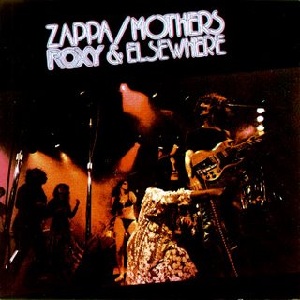
Roxy & Elsewhere
By Frank Zappa
The Story
Released in September 1974, Roxy & Elsewhere captured Frank Zappa’s mid-1970s band in a live setting and showcased one of his most tightly rehearsed ensembles. Most of the album was recorded over several December 1973 concerts at the Roxy Theatre in Hollywood, with additional material recorded at other venues. The performances blend complex instrumental passages, humor, audience interaction, and extended improvisation, reflecting Zappa’s approach to live concerts as structured compositions rather than loose jams.
The album opens with Penguin in Bondage, which establishes the conversational tone between Zappa and the audience while introducing the band’s tight ensemble playing. Pygmy Twylyte follows with rapid rhythmic shifts and intricate arrangement, highlighting the group’s precision. Dummy Up expands the live atmosphere further, featuring spontaneous audience participation woven into the performance, demonstrating how Zappa incorporated unpredictable elements into carefully shaped structures.
Village of the Sun transitions into Echidna's Arf (Of You) and then into Don't You Ever Wash That Thing?, forming a continuous sequence that emphasizes instrumental complexity. These pieces feature shifting time signatures, unison lines, and extended solos, illustrating the technical level of the ensemble. The musicians move fluidly between composed sections and improvisational passages, reinforcing Zappa’s method of blending written material with live interpretation.
Cheepnis introduces a humorous tribute to low-budget monster movies, combining spoken narration with structured ensemble playing. The performance balances comedy with intricate musical backing, a hallmark of Zappa’s live shows during this period. Son of Orange County follows, featuring melodic guitar passages and vocal harmonies that contrast with the more rhythmically dense pieces earlier in the album.
More Trouble Every Day revisits material originally written in the 1960s, reworked into a more elaborate arrangement with extended instrumental interplay. The album concludes with Be-Bop Tango (Of the Old Jazzmen's Church), a lengthy performance that combines composed sections, improvisation, and audience participation. The piece gradually builds through complex rhythmic patterns before dissolving into interactive segments, capturing the theatrical nature of Zappa’s concerts.
Roxy & Elsewhere is often regarded as a defining document of Zappa’s mid-1970s band, emphasizing precision, humor, and compositional ambition in a live context. The album demonstrates how his ensembles could execute demanding arrangements while maintaining spontaneity. By combining structured writing, improvisation, and audience interaction, Roxy & Elsewhere presents a vivid portrait of Zappa’s live performance approach.