
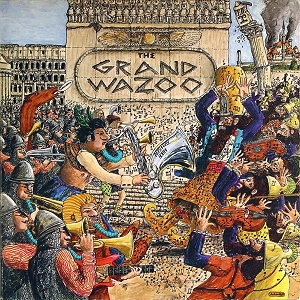
The Grand Wazoo
By Frank Zappa
The Story
Released in November 1972, The Grand Wazoo continued Frank Zappa’s early-1970s shift toward large-scale jazz-rock composition. Recorded while he was still recovering from the injuries sustained in late 1971, the album expanded the horn-driven approach introduced on Waka/Jawaka, featuring a larger ensemble and more elaborate arrangements. Instead of focusing on satire or collage, Zappa emphasized instrumental writing, layered orchestration, and extended development across long-form pieces.
The opening track, For Calvin (And His Next Two Hitch-Hikers), establishes the album’s tone with a tightly arranged instrumental built around shifting rhythms and interlocking horn lines. The piece blends rock rhythm section elements with brass and woodwinds, reflecting Zappa’s interest in combining big-band textures with electric instrumentation. This approach continues into the title track, The Grand Wazoo, which occupies much of the first side and serves as the album’s central composition.
The Grand Wazoo develops through multiple sections, alternating between composed ensemble passages and improvisational solos. The arrangement highlights the expanded lineup, with horns carrying melodic themes while the rhythm section provides changing grooves underneath. Rather than repeating a single structure, the piece evolves gradually, moving between contrasting segments while maintaining thematic continuity. This large-scale format reflects Zappa’s increasing focus on orchestral-style rock composition during this period.
The second half of the album shifts to shorter but still complex instrumentals. Cletus Awreetus-Awrightus combines fast-paced ensemble writing with tightly coordinated horn figures. Eat That Question moves toward a groove-oriented structure, emphasizing keyboard-driven improvisation over a steady rhythmic foundation. These tracks provide contrast to the expansive title composition while maintaining the album’s emphasis on instrumental interplay.
The closing piece, Blessed Relief, adopts a more relaxed tempo and melodic focus, offering a calmer conclusion after the dense arrangements that precede it. The track highlights ensemble balance and sustained harmonic movement, bringing the album to a measured and reflective ending.
The Grand Wazoo represents one of Zappa’s most fully realized large-ensemble jazz-rock recordings. By emphasizing horns, extended compositions, and structured improvisation, the album continues the direction introduced earlier in 1972 while refining the balance between arrangement and spontaneity. It stands as a key example of Zappa’s early-1970s orchestral rock approach and his interest in blending big-band writing with electric instrumentation.