
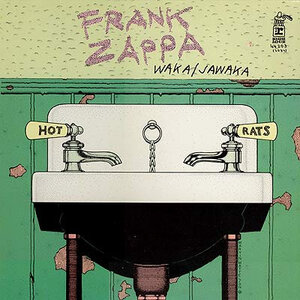
Waka/Jawaka
By Frank Zappa
The Story
Released in July 1972, Waka/Jawaka marked Frank Zappa’s return to recording after the injuries he sustained in late 1971, when he was pushed from a stage during a concert in London. During his recovery, Zappa focused on composition and studio work, assembling a new group of musicians and moving further into jazz-influenced instrumental writing. The album reflects this shift, emphasizing extended arrangements, complex ensemble interplay, and structured improvisation rather than the collage-based approach of his late-1960s recordings.
The opening track, Big Swifty, sets the tone with a long instrumental built around recurring themes and shifting sections. The arrangement blends rock rhythm with brass and woodwind parts, creating a layered texture that highlights Zappa’s interest in large ensemble writing. Rather than relying on conventional verse-chorus structures, the piece unfolds through evolving motifs and solo passages, establishing the album’s focus on composition-driven jazz rock.
Your Mouth provides a shorter vocal-based contrast, featuring satirical lyrics framed within a tightly arranged instrumental backing. The following track, It Just Might Be a One-Shot Deal, expands the palette further, combining acoustic textures, slide guitar, and ensemble passages. The arrangement moves between quieter sections and fuller instrumentation, demonstrating Zappa’s interest in dynamic contrast within a single piece.
The title track, Waka/Jawaka, occupies the second half of the album and serves as its central composition. Built around a prominent horn-driven theme, the piece develops through multiple sections, alternating between arranged passages and improvisational solos. The writing emphasizes ensemble precision, with brass and rhythm sections interacting across shifting grooves. This large-scale structure reflects Zappa’s increasing focus on jazz-oriented composition during the early 1970s.
Waka/Jawaka is often seen as part of a transitional period in Zappa’s catalog, bridging earlier experimental rock work with the more elaborate jazz-rock albums that followed. The emphasis on horns, extended instrumental development, and structured improvisation would continue on later releases. Rather than relying on satire and collage, the album highlights Zappa’s role as a composer and bandleader, using the studio to capture detailed ensemble arrangements.
The result is a concise but musically dense album built around long-form composition and jazz-influenced interplay. Waka/Jawaka demonstrates Zappa’s shift toward orchestral-style rock arrangements and marks a key step in his early-1970s instrumental direction.