
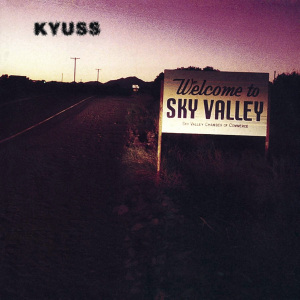
Welcome to Sky Valley
By Kyuss
The Story
Released on June 28, 1994, Welcome to Sky Valley marked a creative peak for Kyuss and further defined the desert rock sound they had established on Blues for the Red Sun. The band—Josh Homme, John Garcia, Nick Oliveri, and Brant Bjork—expanded their approach by structuring the album as three continuous suites rather than a traditional collection of separate tracks. This format reflects their live performance style, where songs often flowed into one another without clear breaks.
Recorded with producer Chris Goss, the album emphasizes a warm, organic sound that captures both the weight of the band’s riffs and the spacious atmosphere associated with their desert origins. The production allows the instruments to blend into a thick, immersive texture, with Josh Homme’s guitar tone remaining central. His use of low-end frequencies and fuzz creates a dense sonic layer, often merging with Nick Oliveri’s bass. Brant Bjork’s drumming provides a steady, groove-oriented foundation, while John Garcia’s vocals sit within the mix rather than dominating it.
The first section begins with Gardenia, which sets the tone with a steady groove and layered guitar textures. Asteroid and Supa Scoopa and Mighty Scoop continue the momentum, building on repetition and gradual development. 100° maintains the driving rhythm before the section transitions into the second suite.
Space Cadet opens the middle section with a quieter, more melodic arrangement centered on acoustic guitar, providing contrast to the heavier material. Demon Cleaner follows as one of the album’s most recognizable tracks, combining a strong riff with a more direct structure. Odyssey expands into a longer, evolving composition, bridging into the final section.
The third suite includes Conan Troutman and N.O., which return to heavier, groove-driven structures. Whitewater closes the album with a more expansive and atmospheric arrangement, gradually building and resolving the record’s overall flow.
Welcome to Sky Valley emphasizes continuity, groove, and atmosphere. By structuring the album as interconnected sections and focusing on tonal depth rather than traditional song formats, Kyuss created a cohesive listening experience. The album captures the band’s balance between heavy riffs and open space, solidifying their influence on stoner rock and establishing a distinctive approach to album composition.