
Kyuss
Biography
Kyuss came out of a place that did not behave like a normal rock scene. Palm Desert, California, was far from the club circuits that shaped most young bands in Los Angeles, San Francisco, or Seattle. The teenagers who formed Kyuss were surrounded by open desert, empty roads, heat, dirt, and very little formal infrastructure for live music. That isolation became part of their identity. Instead of learning how to please club bookers, they learned how to hold attention at outdoor parties powered by generators, where the sound had to travel through open air and the crowd could simply walk away if the band was boring. That setting helps explain why Kyuss sounded so huge, loose, and physical. Their music did not feel designed for a stage with lights and a dressing room. It felt like it had been built to shake through sand after midnight.
The band began in the late 1980s under the name Katzenjammer, with John Garcia on vocals, Josh Homme on guitar, Brant Bjork on drums, and Chris Cockrell on bass. Nick Oliveri was also part of the earliest circle, playing rhythm guitar before later becoming the band's bassist. They soon became Sons of Kyuss, a name taken from a creature in the fantasy role-playing game 'Advanced Dungeons & Dragons', and released a self-financed recording under that name in 1990. By the time they shortened the name to Kyuss, the core personality of the group was already clear: Garcia's raw, soulful bark; Homme's unusually low, thick guitar tone; Bjork's rolling, unhurried drumming; and a sense of space that separated them from both thrash metal and mainstream hard rock.
Kyuss were often described later as a stoner rock or desert rock band, but at the beginning they were simply a group of young musicians pushing heavy music away from polish and toward atmosphere. Homme tuned low and was known for using bass cabinets to give his guitar a wider, heavier physical presence. That choice mattered. His playing was not only about riffs; it was about air pressure, sustain, and the way a chord could hang in the room. Brant Bjork's drumming also gave the band a different feel from much heavy rock of the period. He could hit hard, but he did not make the music stiff. His grooves often rolled forward with a relaxed swing, closer to the movement of a long drive than to the rigid attack of metal. John Garcia stood at the front with a voice that could sound desperate, commanding, and weather-beaten without becoming theatrical in the usual glam-metal sense.
The first Kyuss album, 'Wretch', arrived in 1991 and captured a band still close to its punkish beginnings. Some of the material came from the Sons of Kyuss period, and the record has a rougher, more cramped sound than the albums that followed. It is important less as a finished statement than as a document of a young band discovering its weight. Songs such as 'Hwy 74' and 'Love Has Passed Me By' show the basic pieces already in place: low-end heaviness, restless tempo shifts, and Garcia's voice pushing against the grain of Homme's guitar. But 'Wretch' did not yet fully capture the openness that made Kyuss special. The band needed a producer who could understand that heaviness did not have to mean compression, and that their best qualities were not always the most obvious ones.
That person was Chris Goss, the singer and guitarist of Masters of Reality, who became one of the most important outside figures in the Kyuss story. Goss produced 'Blues for the Red Sun', released in 1992, with the band, and helped them find a recorded sound closer to the strange power of their live identity. The album was a major leap. It was heavier than 'Wretch', but also more spacious, more colorful, and more confident. Its title itself suggested the band's environment: heat, glare, distance, and a blues feeling filtered through distorted amplifiers. The record did not chase the speed or technical display common in metal at the time. It stretched out, breathed, and treated repetition as a source of hypnosis.
'Blues for the Red Sun' is where Kyuss became unmistakable. 'Thumb' moves with a slow, massive confidence, Garcia sounding as if he is singing from inside the riff rather than over it. 'Green Machine' is more direct and aggressive, but even there the guitar tone has a dusty, rounded thickness that made the song feel different from the harder rock playing on radio in the early 1990s. '50 Million Year Trip' showed another side of the band, opening into a long instrumental passage that felt less like a conventional solo section than a landscape. Kyuss could be blunt, but they were not narrow. They knew how to let a riff become a place.
The album also marked the end of Nick Oliveri's first major phase with the band. Oliveri's bass playing and wild energy were part of the early Kyuss character, but he left around the time of 'Blues for the Red Sun' and was replaced by Scott Reeder, formerly of The Obsessed. Reeder changed the center of gravity. His bass style was fluid, melodic, and deeply locked into the band's low-tuned sound. With him, Kyuss became less scrappy and more expansive. The shift did not make the band softer. It made them deeper. Reeder's arrival helped turn Kyuss from a promising heavy band into one capable of making a fully realized album-length journey.
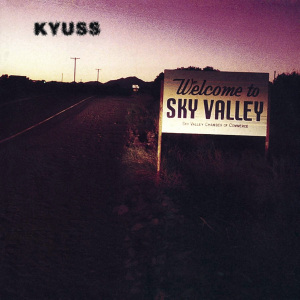
That journey was 'Welcome to Sky Valley', released in 1994. Recorded at Sound City Studios in Van Nuys and produced by Kyuss with Chris Goss, with Joe Barresi involved in engineering and mixing, it is often treated as the band's defining work for good reason. The album was originally structured as three extended suites rather than a simple list of separate songs, which matched the way Kyuss understood momentum. Instead of presenting a collection of singles, the record plays like a desert drive divided into long stretches. The sound is warmer and more immersive than 'Blues for the Red Sun', with Homme's guitar spreading across the mix, Reeder's bass moving like a second engine underneath it, and Bjork's drums keeping the songs human rather than mechanical.
'Welcome to Sky Valley' also showed how much range Kyuss had within their own narrow-looking world. 'Gardenia' is heavy and instantly gripping, but its power comes from patience as much as force. 'Asteroid' turns repetition into atmosphere, circling a riff until the listener is pulled into its orbit. 'Demon Cleaner' is one of the band's most elegant pieces, built on restraint, groove, and a vocal performance from Garcia that proves he did not need to shout to sound intense. The album's cover of 'N.O.' by the desert-scene band Across the River also pointed back to the community around them, especially figures such as Mario Lalli, whose work with Across the River and Yawning Man helped shape the wider Palm Desert musical environment.
Part of what made Kyuss unusual was that they were both intensely local and unexpectedly influential. They were not a band manufactured by a city scene with a clear media narrative. Their mythology came from generator parties, desert distances, cheap equipment, and a network of musicians who played because there was not much else to do. That background gave their music a practical wildness. Long songs were not an abstract progressive-rock gesture; they made sense in a place where a band could stretch out under the open sky. Heavy riffs were not only a metal inheritance; they were a way to fill physical space.
Yet Kyuss were never simply a jam band. Their best songs are carefully shaped even when they feel loose. Homme's riffs often depend on small rhythmic turns rather than obvious complexity. Bjork's drumming gives the music a rolling pulse that keeps it from becoming static. Garcia's lyrics were not always the central focus, but his delivery gave the songs human urgency. Reeder, especially on 'Welcome to Sky Valley', brought a sense of melodic movement that made the low end feel alive. This combination helped explain why so many later bands borrowed from Kyuss but rarely sounded as natural. The ingredients were easy to describe: downtuned guitars, Sabbath weight, desert imagery, extended grooves. The chemistry was much harder to reproduce.
After 'Welcome to Sky Valley', Kyuss were in a strange position. Their reputation was growing, especially among musicians and committed heavy-rock listeners, but they were not becoming a major commercial act. They toured, earned critical respect, and attracted the kind of devoted audience that later made them seem bigger in retrospect than they were in the moment. At the same time, internal changes continued. Brant Bjork left the band in 1994 and later spoke in interviews about frustration with the experience. Alfredo Hernandez replaced him on drums, bringing a different attack for the band's final studio album.
'...And the Circus Leaves Town', released in 1995, is sometimes overshadowed by 'Blues for the Red Sun' and 'Welcome to Sky Valley', but it is a crucial part of the story. It sounds like a band both refining and exhausting its language. The production is cleaner in places, the playing is strong, and songs such as 'One Inch Man', 'Hurricane', and 'El Rodeo' show that Kyuss could still make heavy music with swing and personality. There is also a darker, more resigned feeling across parts of the album, as if the endless-road freedom of earlier records had begun to feel more like a trap. Hernandez was a powerful drummer, but Bjork's absence changed the internal feel. The band was still Kyuss, but the balance had shifted.
Kyuss broke up in 1995, not long after releasing '...And the Circus Leaves Town'. At the time, they had not achieved the level of mainstream success that would have made the split seem like a major industry event. Their influence, however, grew steadily after they were gone. Josh Homme briefly played with Screaming Trees and then developed The Desert Sessions, a loose recording project that carried forward some of the collaborative Palm Desert spirit. He later formed Queens of the Stone Age, bringing Alfredo Hernandez into the early lineup and eventually reuniting with Nick Oliveri for the band's commercial breakthrough period. John Garcia went on to Slo Burn, Unida, Hermano, and solo work. Brant Bjork became a solo artist and also played with Fu Manchu. Scott Reeder became a respected bassist and producer. Oliveri formed Mondo Generator and remained one of heavy rock's most volatile characters.
The post-Kyuss years also showed how complicated the band's legacy had become. In 2010, John Garcia, Brant Bjork, and Nick Oliveri became involved in Kyuss Lives!, a project built around performing Kyuss material with guitarist Bruno Fevery. Josh Homme and Scott Reeder later took legal action over the use of the Kyuss name, and the project eventually continued as Vista Chino. The dispute underlined a difficult truth: Kyuss had become valuable after the fact. A band that had once seemed too strange, too heavy, and too tied to its own environment for mainstream success had become a name with real cultural weight.
Kyuss matter because they changed the possibilities of heavy rock without sounding like they were trying to start a movement. They offered an alternative to the slickness of late 1980s hard rock, the speed race of thrash, and the angst-centered framing of early 1990s alternative music. Their songs were heavy but not macho in a simple way, psychedelic but not delicate, repetitive but not lazy. They treated volume as atmosphere and groove as architecture. Their records helped define stoner rock and desert rock, but the best of their music still feels less like a genre exercise than a natural result of people, place, and instinct meeting at the right time.
Today Kyuss are often remembered as a cult band with influence far beyond their sales. That description is accurate, but it can make them sound smaller than they were creatively. Their catalog is brief, uneven in places, and tied to a very specific period, yet it opened a road that countless bands followed. 'Blues for the Red Sun' gave desert heaviness a recorded shape. 'Welcome to Sky Valley' turned that shape into a complete world. '...And the Circus Leaves Town' showed the sound beginning to fray just as its impact was spreading. Kyuss did not last long, and perhaps that is part of why their music kept its charge. They appeared, grew heavier and stranger, left behind a handful of records, and disappeared before their own legend could become routine.