
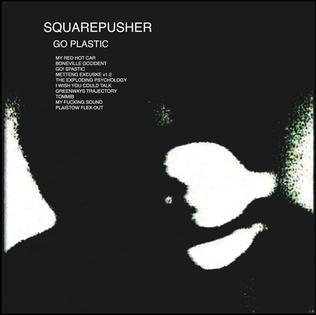
Go Plastic
By Squarepusher
The Story
Released by Warp in June 2001, Go Plastic arrived at a turning point in Tom Jenkinson’s Squarepusher catalog. In the years before it, he had already built a reputation for combining impossible-looking breakbeat programming with bass playing, jazz-fusion instincts, and a restless refusal to sit still stylistically. But Go Plastic stands out because it pushed hard in one direction: away from the more obviously live-instrument feel that had shaped parts of earlier records and toward a colder, faster, more synthetic design. Jenkinson later described that period as one where he had moved about as far from melody as he ever had, and the album captures that impulse in full.
What makes Go Plastic especially striking is that its mechanical intensity was not simply a matter of using a computer to smooth everything into digital perfection. Jenkinson spoke at the time about being tired of real instruments and wanting a sound that was more brutal and digital, yet the album was built with a hardware-heavy setup rather than conventional computer production. That tension helps explain why the record feels so physical even at its most artificial. The beats do not just race; they seem carved, bent, and reassembled in real time. Instead of presenting rhythm as a stable grid, Jenkinson treats it almost like a living material, constantly mutating the shape of the tracks from within.
The album opens with one of the key reasons Go Plastic became a landmark for listeners beyond Squarepusher’s core audience. “My Red Hot Car,” which had already appeared as a single in 2001, is one of the most approachable tracks he ever made without surrendering his identity. Its vocal hook and bright, darting energy give the album an entry point, but the song still belongs completely to the larger aesthetic of the record: playful on the surface, highly controlled underneath, and packed with detail. In interviews around the release, Jenkinson acknowledged that many people saw it as a rare Squarepusher track they could use to introduce friends to his music. That accessibility matters because it frames the rest of Go Plastic not as pure abstraction, but as an album deliberately balancing invitation and resistance.
From there, the record becomes more severe and more immersive. Tracks like “Boneville Occident,” “Go! Spastic,” and “The Exploding Psychology” turn speed and fragmentation into the album’s emotional language. Even when the music sounds chaotic, it is widely noted for how precise it is. Reviews at the time emphasized that the album was not just noise for its own sake; each sound seemed to have a role inside the larger design. That sense of purpose is part of why Go Plastic has endured. It is extreme music, but not careless music.
There are also flashes of contrast that keep the album from becoming one-note. “Tommib” briefly pulls the energy inward, and “Plaistow Flex Out” closes the record in a more spacious and reflective mood. Those moments are important because they reveal that Go Plastic was never only about speed or aggression. It was also about atmosphere, pressure, and release. Even in one of his most abrasive phases, Jenkinson was still shaping an album rather than just a demonstration of technique.
In retrospect, Go Plastic is often treated as one of the defining Squarepusher releases because it crystallized a particular side of his art: futuristic, confrontational, hyper-detailed, and weirdly danceable. It did not erase the jazz-minded or instrumental sides of his work, but it forced them into a new electronic language. The result is an album that sounds like Jenkinson testing how far he could push synthetic rhythm before it broke, then discovering that the breakage itself could become the music.