
Squarepusher
Biography
Squarepusher is the main recording identity of Tom Jenkinson, an English musician, producer, bassist, programmer, and composer whose work has spent around three decades pushing against the border between human performance and machine logic. Born in Chelmsford, Essex, in 1975, Jenkinson came into music from two directions that were not supposed to fit together neatly: the physical discipline of electric bass playing and the fast-mutating world of early 1990s electronic music. That tension became the engine of Squarepusher. His records can sound like jazz fusion being torn apart by a computer, or like rave music suddenly interrupted by a fretless bass solo, or like a private argument between melody, rhythm, noise, and pure technical obsession. What made him unusual from the beginning was not simply speed or complexity, but the way he treated complexity as a form of expression rather than decoration.
Jenkinson grew up in a musical household and took to the bass guitar seriously as a teenager. The instrument was not a casual accessory for him. It became central to how he heard rhythm, harmony, and motion. He was drawn to players associated with jazz, funk, and fusion, and that background gave his electronic work a different kind of body from many of his peers. At the same time, the British underground was being reshaped by acid house, hardcore, jungle, techno, and the experimental electronic music that later gathered around labels such as Warp and Rephlex. Jenkinson absorbed the excitement of that period not as a club purist but as someone fascinated by systems: sequencers, samplers, drum programming, signal processing, and the possibility of making rhythms that no drummer could comfortably play but that still seemed to breathe.
Before Squarepusher became widely known, Jenkinson released music under names including Tom Jenkinson and Duke of Harringay. His early work already showed the split personality that would define him: rough breakbeats, acid lines, melodic fragments, and a restless refusal to stay inside one genre. A key early moment came through his connection with Richard D. James, better known as Aphex Twin, whose Rephlex label released Jenkinson's 1996 album 'Feed Me Weird Things'. That record did not sound like a debut by someone asking politely to enter electronic music. It sounded like a young musician trying to overload the form from inside. Tracks such as 'Tundra' and 'Kodack' combined drum and bass velocity with twisted melodic writing, while 'Theme From Ernest Borgnine' showed his gift for making fast, programmed music feel strangely warm and humorous. The album's title was apt: it felt like a demand for oddness, a hunger for unusual shapes.
'Feed Me Weird Things' established the Squarepusher language, but 'Hard Normal Daddy', released by Warp in 1997, made that language more vivid and more complete. It remains one of Jenkinson's defining records because it captures the moment when his love of jazz fusion, jungle, acid, and home-studio experimentation fused into something that sounded completely his own. The bass guitar on the album is not simply layered over electronic tracks; it is part of the argument of the music. On 'Coopers World', the bass runs and synthetic chords move with a bright, playful looseness, while the drums behave with impossible precision. 'Vic Acid' and 'E8 Boogie' show the harsher, more acidic side of the record, full of clipped funk and hyperactive programming. The title itself suggested one of Jenkinson's characteristic jokes: a warped version of normality, a suburban phrase bent into cartoon oddness. The album arrived during a period when so-called intelligent dance music was often accused of being cold or cerebral, but 'Hard Normal Daddy' was too funny, funky, and physically wired to be merely academic.
A useful way to understand Jenkinson's personality as a musician is to look at how often he has resisted easy labels. He was not only interested in making electronic tracks that impressed producers; he wanted the material to test the assumptions of listeners who thought they knew what jazz, drum and bass, or programming should do. In interviews across his career, he has often pushed back against reductions of his music to technical display. That resistance matters because Squarepusher's best work is not just a demonstration of speed. It is built around contrast: violent edits against gentle chords, comic titles against serious musicianship, machine precision against the very human sound of fingers on strings.
After 'Hard Normal Daddy', Jenkinson made one of the sharpest turns of his career with 'Music Is Rotted One Note' in 1998. Where earlier Squarepusher records often foregrounded programmed breaks and digital speed, this album leaned into a murkier, more live-sounding world inspired by electric jazz and fusion. It is an important release because it proved that Jenkinson's interest in jazz was not a decorative sample source. He played many of the instruments himself, and the record has the feeling of a band trapped in damaged tape, half remembered from a smoky rehearsal room and half reconstructed by machines. The title implies decay, and the music often sounds deliberately corroded: drums feel loose and unstable, electric piano and bass lines drift through fog, and the production refuses the shiny clarity that might have made the virtuosity easier to consume. Instead of using jazz to make electronic music smoother, Jenkinson used it to make the music stranger.
That willingness to swerve became a pattern. 'Selection Sixteen' in 1999 gathered different sides of his late 1990s output: fractured breakbeat experiments, melodic sketches, and bass-led pieces that seemed to move between private study and club damage. 'Go Plastic', released in 2001, pushed the digital side harder. If 'Music Is Rotted One Note' felt like organic material decomposing, 'Go Plastic' felt like a machine developing a nervous system. Its most famous track, 'My Red Hot Car', gave Squarepusher one of his clearest entry points for a wider audience, partly because it wrapped his chaotic programming around a strangely catchy vocal hook. The album's surfaces were sharper, more synthetic, and more aggressive than his fusion-oriented work, and it arrived at a moment when computer-based production was changing rapidly. Jenkinson did not simply use software to tidy up ideas; he treated it as an environment where rhythm could be stretched, shredded, and rebuilt.
The early 2000s also showed Jenkinson's fondness for refusing a single public image. 'Do You Know Squarepusher' in 2002 was sprawling, abrasive, funny, and sometimes confrontational, with tracks that moved from electronic overload to live performance energy. Then came 'Ultravisitor' in 2004, one of the most ambitious records in the Squarepusher catalogue. It combined studio constructions with live recordings, audience noise, bass improvisation, and pieces that blurred the line between concert document and electronic composition. The title track opens like a collision between a live band and a malfunctioning machine, while 'Iambic 9 Poetry' reveals one of Jenkinson's most beautiful melodic instincts. That contrast is central to the album's power. It can be punishing one moment and unexpectedly tender the next. 'Ultravisitor' also made clear that Squarepusher was not interested in electronic music as something sealed away from performance. The stage, the body, the crowd, the mistake, and the instrument all remained part of his vocabulary.
One of the most revealing events around this period was his appearance in contexts that placed electronic musicians beside contemporary classical performers. In 2004, Squarepusher appeared on a bill with the London Sinfonietta and Jamie Lidell at London's Royal Festival Hall, in a program that also included works by composers such as Steve Reich, John Cage, and Edgard Varese. The pairing made sense. Jenkinson's music, for all its rave roots and bass guitar flash, shared a concern with structure, texture, and process. Yet he did not simply become a respectable concert-hall composer. The appeal was in the friction: Squarepusher could belong next to modern composition and still sound like an unruly outsider.
'Hello Everything', released in 2006, brought a brighter, more melodic surface back into his work. Compared with some of the more abrasive records before it, the album often feels colorful and almost playful, though still rhythmically dense. Pieces such as 'Welcome To Europe' and 'Planetarium' show Jenkinson's ability to write music that is both technically crowded and emotionally open. Around this period he also became increasingly explicit in interviews about method, intention, and the problem of being misunderstood as merely difficult. He could be combative in the way serious experimental musicians often are, but his work also had a mischievous streak. The titles, sudden stylistic detours, and refusal to behave tastefully all suggest a musician who enjoyed sabotaging expectations.
In 2008, 'Just A Souvenir' offered another distinctive chapter. Jenkinson described the project as connected to an imagined concert by a strange band, and the record leaned into a more live, group-like sound even though it was still filtered through his singular approach. It is one of his more divisive records, but it matters because it led naturally into Shobaleader One, the masked band project that allowed him to externalize some of the funk, fusion, and performance elements that had always been embedded in Squarepusher. Shobaleader One was not just a side gimmick; it was a way of turning the fantasy of an impossible electronic fusion band into a physical stage act. The group's later live album 'Elektrac' reworked Squarepusher material with a band setup, showing how much of his supposedly computer-bound writing could survive as muscular, human performance.
Then, in 2009, Jenkinson made one of his most stripped-down statements with 'Solo Electric Bass 1'. The album was recorded live in one take at Cite de la Musique in Paris, with no editing afterward. For an artist known for dense programming and technological manipulation, releasing an album of unadorned solo bass pieces was a revealing move. It was not a retreat from technology so much as a challenge to the way people heard him. The record said, in effect, that the instrumental discipline behind Squarepusher was real. No glitch, no drum programming, no digital camouflage - just fingers, strings, timing, and composition. It also exposed the risk in his work: when the machinery disappears, the musician has nowhere to hide.
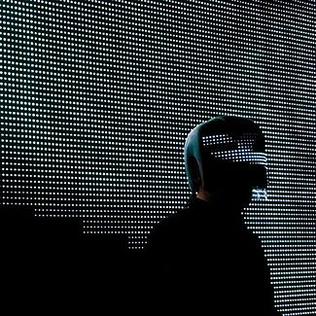
The 2010s brought a more visual and futuristic phase. 'Ufabulum', released in 2012, arrived with a live show built around an LED helmet and a large LED display, making the performance itself part of the machine aesthetic. The album emphasized hard-edged synthesis, sequenced melodies, and a clean electronic attack. It was less interested in the jazz-fusion warmth of the 1990s and more focused on luminous, high-pressure digital architecture. 'Dark Steering' became one of its signature pieces, matching rapid melodic movement with a visual identity that felt almost cybernetic. The helmet could have been a gimmick in weaker hands, but for Squarepusher it fit a long-running idea: the musician as both visible performer and hidden operator, half human, half interface.
'Damogen Furies' followed in 2015 and continued the emphasis on pure electronics, but with a rougher and more forceful sound. Jenkinson framed the record around custom-built software and real-time performance systems rather than conventional computer-based playback. The album's titles, such as 'Stor Eiglass' and 'Baltang Ort', carried his fondness for strange invented language, while the music often felt like club energy rebuilt into jagged, unpredictable forms. It was not a nostalgic return to 1990s drill and bass, but it did reconnect with the idea of Squarepusher as a producer who could make rhythm feel both exciting and unstable.
After a gap in major Squarepusher albums, 'Be Up A Hello' appeared in 2020. Warp described it as a return to the vintage hardware Jenkinson had used in his early 1990s work, and that detail matters. The record did not simply imitate his old sound, but it did reconnect with the tactile pleasure of machines that have limits, quirks, and personalities. Tracks such as 'Oberlove', 'Hitsonu', and 'Nervelevers' carried flashes of acid, breakbeat pressure, and melodic brightness. The album was also connected to a personal loss: Jenkinson dedicated it to his childhood friend Chris Marshall, whose death affected the project. That context gives the record a different emotional weight. Beneath the speed and circuitry, 'Be Up A Hello' often feels like a conversation with memory: old machines, old friendships, and old methods brought back into motion.
The next major release, 'Dostrotime' in 2024, showed that Squarepusher had not settled into heritage-act repetition. The album was promoted in an appropriately cryptic way, including an email to subscribers with an audio file whose oscilloscope display revealed the word 'Dostrotime'. That small event is a perfect Squarepusher anecdote: technical, playful, slightly secretive, and dependent on listeners being curious enough to decode the clue. Musically, the album returned to high-density electronic writing, with pieces such as 'Wendorlan' and 'Enbounce' moving through intricate rhythmic pressure and glowing melodic fragments. It also carried traces of the strange quiet of the COVID-19 lockdown period, which Jenkinson linked to the atmosphere around the record. Rather than making a plainly reflective lockdown album, he turned that silence into something alien and active.
Squarepusher's recent catalogue has also included archival and reissue activity, including the 25th anniversary remaster of 'Feed Me Weird Things' and the 2025 release 'Stereotype', a reissue of material originally self-released under that name in 1994. Hearing that early material in retrospect is valuable because it shows the raw ingredients: acid, breakbeat, rave energy, and a young producer testing the edges of his equipment. By 2026, with 'Kammerkonzert', Jenkinson was still releasing new work through Warp rather than simply curating his past. The title, which means 'chamber concert' in German, suggested another of his long-running fascinations: the collision between electronic systems and older ideas of composed performance.
What makes Squarepusher important is not just that the music is complicated. Many artists can make complex music. Jenkinson's distinction lies in the way he makes complexity feel personal. His bass playing gives the music a human nervous system; his programming gives it impossible speed and architecture; his melodic writing often sneaks warmth into places that seem designed to resist it. He has never treated genre as a home. Drum and bass, acid techno, jazz fusion, electroacoustic music, funk, and contemporary composition all pass through his work, but none of them contain it. At his best, he sounds like someone taking a familiar musical language and asking what happens when its physical limits are removed.
His influence can be heard across experimental electronic music, drill and bass, IDM, and the wider culture of producers who treat software not merely as a recording tool but as an instrument with its own grammar. Yet Squarepusher's legacy is also tied to musicianship in the older sense. He is one of the rare electronic artists whose reputation depends as much on instrumental ability as on programming. That combination has made him difficult to classify, and that difficulty is part of the point. Squarepusher has spent his career refusing the comfortable split between the virtuoso and the programmer, the jazz musician and the raver, the serious composer and the prankster. Tom Jenkinson's music lives in the argument between those identities, and the argument still sounds unfinished.