
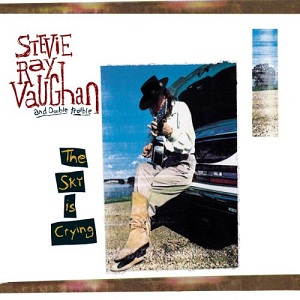
The Sky Is Crying
The Story
Released on November 5, 1991, The Sky Is Crying was compiled after Stevie Ray Vaughan’s death in August 1990 and assembled from previously unreleased studio recordings spanning several years. The material came from sessions recorded between the mid-1980s and 1989, reflecting different periods of Vaughan’s development. Rather than being conceived as a single album, the release was curated to present a cohesive listening experience that highlighted both his blues roots and his evolving tone following his recovery in the late 1980s.
The album opens with Boot Hill, a slow instrumental built around sustained phrasing and controlled dynamics, immediately setting a reflective tone. The title track, The Sky Is Crying, originally written and recorded by Elmore James, is presented as a restrained blues performance emphasizing Vaughan’s expressive vibrato and measured pacing. Empty Arms appears in a different version from the earlier studio release, offering a more relaxed interpretation that contrasts with the tighter arrangement heard previously.
Little Wing, Vaughan’s interpretation of the Jimi Hendrix composition, became one of the album’s most recognized performances. The instrumental arrangement focuses on melody and tone, avoiding vocals and allowing the guitar to carry the emotional weight. Wham! follows with a faster instrumental, reflecting Vaughan’s admiration for earlier electric blues styles. May I Have a Talk with You returns to a traditional blues structure, while Close to You introduces a brass arrangement, expanding the sonic palette beyond the standard band format.
Chitlins con Carne, written by Kenny Burrell, continues the instrumental focus with a relaxed groove and subtle phrasing. So Excited provides a more energetic closing track, contrasting with the reflective tone of much of the album.
Because the recordings were drawn from multiple sessions, The Sky Is Crying functions as a retrospective rather than a unified studio statement. The sequencing emphasizes Vaughan’s versatility, moving between slow blues, instrumentals, and more upbeat material. The album highlights his tone, phrasing, and interpretive approach, particularly in the later recordings made after his recovery, which feature a cleaner sound and more controlled dynamics. As a posthumous release, it serves as a final collection of previously unheard performances, documenting Stevie Ray Vaughan’s continued growth and deep connection to blues tradition.