
Black Sabbath
Biography
Black Sabbath began in Birmingham, England, a city whose postwar industrial landscape, factories, and working-class pressure shaped the sound of the band as much as any record collection did. Tony Iommi, Geezer Butler, Ozzy Osbourne, and Bill Ward were not raised in a glamorous music scene. They came from Aston and nearby parts of Birmingham, where industrial noise was part of daily life and music looked like one of the few ways out. Before they became Black Sabbath, they played under names including the Polka Tulk Blues Band and Earth, working through blues, jazz, and hard rock influences in the late 1960s club circuit. They were not originally trying to invent heavy metal. They were trying to make music that felt stronger, darker, and more physical than the blues-rock around them.
One of the most important events in the band happened before the band had fully become itself. Tony Iommi worked in a sheet metal factory, and on what was supposed to be his last day there, he injured the tips of two fingers on his right hand. Because he was a left-handed guitarist, those damaged fingers were on his fretting hand. At first, the injury seemed like it might end his playing. Instead, Iommi made homemade plastic fingertips, used lighter strings, and began tuning his guitar down to reduce tension. That practical solution became part of the Black Sabbath sound: heavier, darker, looser, and more ominous. What began as a physical limitation helped create one of rock music's most recognizable guitar tones.
The band took the name Black Sabbath from the 1963 horror film starring Boris Karloff, after noticing how people would pay to be frightened. Geezer Butler, who had an interest in occult literature and darker subject matter, helped steer the lyrics away from standard love songs and toward fear, war, confusion, social collapse, and spiritual dread. Their first album, 'Black Sabbath', released in 1970, opened with rain, a church bell, and the tritone riff of the title track. It sounded less like a normal rock song than a door opening into a nightmare. Ozzy Osbourne did not sing with polished technique, but his voice had a strange, alarm-like quality that made the music feel human and frightened rather than theatrical. Bill Ward's drumming came from jazz as much as rock, giving the band swing and movement instead of simple heaviness. Geezer Butler's bass did not merely follow Iommi's guitar; it pushed around it, filling the low end with restless motion.
The debut album was recorded quickly with producer Rodger Bain, and that urgency is part of its power. Songs such as 'N.I.B.', 'The Wizard', and 'Behind the Wall of Sleep' still carried traces of blues-rock, but the mood was different from most of their peers. Led Zeppelin could be sensual and mythic, Deep Purple could be flashy and classically sharp, but Black Sabbath sounded like machinery, anxiety, and bad dreams. Critics were often dismissive, but listeners responded strongly. The album gave young audiences a sound that matched fear, boredom, anger, and the strange atmosphere of the early 1970s.
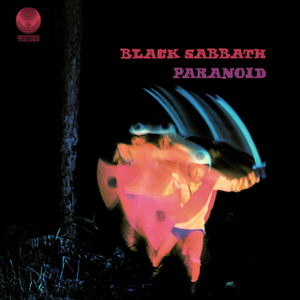
Later in 1970, Black Sabbath released 'Paranoid', the album that turned them from a disturbing new band into a major force. The title track was famously written quickly as a last-minute addition when the album needed another song. Its speed and directness made it one of the band's most accessible singles, but the album around it was far wider and darker. 'War Pigs' transformed anti-war disgust into a slow-building, theatrical attack, with Butler's lyrics condemning the people who send others to fight. 'Iron Man' turned a science-fiction idea into one of the most famous riffs in rock, while 'Electric Funeral' imagined nuclear destruction with a crawling, poisoned guitar sound. 'Fairies Wear Boots' showed the band's humor and groove, proving they were not only doom and dread. 'Paranoid' mattered because it balanced weight with hooks. The songs were heavy, but they were also memorable, almost simple in outline, which allowed their riffs to become part of popular culture.
By 1971's 'Master of Reality', Black Sabbath had deepened their sound even further. Iommi's down-tuned guitar became more central, and the album's relatively short running time made it feel concentrated and severe. 'Sweet Leaf' opened with a coughing sound before locking into one of Sabbath's most massive riffs, while 'Children of the Grave' drove forward with a force that helped shape later heavy metal, punk, and thrash. 'Into the Void' moved with a slow, crushing rhythm that became a blueprint for doom metal and stoner rock. The album also included quieter pieces such as 'Embryo' and 'Orchid', showing that Iommi's writing had a delicate side. 'Master of Reality' is one of the key reasons Sabbath's influence runs so deep: it made heaviness feel like architecture, not just volume.
The band then entered one of its most creative and unstable periods. 'Vol. 4', released in 1972, was recorded in Los Angeles and showed both expansion and excess. The album included the enormous riff of 'Supernaut', the piano-led ballad 'Changes', and the strange instrumental 'FX'. It was less tidy than 'Paranoid' and less monolithic than 'Master of Reality', but it showed a band refusing to repeat itself. The move to America, the pressures of success, and the band's growing appetite for chaos all entered the music. There is a looseness to 'Vol. 4' that can feel dangerous, as if the band is discovering new possibilities while losing control at the same time.
'Sabbath Bloody Sabbath', released in 1973, was another major turning point. After struggling to write at first, the band found inspiration at Clearwell Castle in Gloucestershire, a setting that suited their gothic imagination. The title track opened with one of Iommi's greatest riffs, but the album also brought in more ambitious arrangements, keyboards, and progressive rock textures. Rick Wakeman of Yes contributed keyboards to 'Sabbra Cadabra', adding color without softening the band's identity. Songs such as 'A National Acrobat' and 'Killing Yourself to Live' showed a more complex Sabbath, still heavy but more layered, more reflective, and more confident in the studio. This was not simply a band of frightening riffs anymore; it was a band learning how to build whole worlds around them.
'Sabotage', released in 1975, captured the band under pressure from business disputes and exhaustion. Its anger is audible. 'Hole in the Sky' charges forward with raw force, while 'Symptom of the Universe' contains a riff so aggressive and rhythmically sharp that it later became a major reference point for thrash metal. The album also stretched into unusual territory with 'Megalomania' and 'The Writ', songs full of paranoia, frustration, and dramatic shifts. 'Sabotage' did not have the same commercial smoothness as some earlier releases, but it remains one of the clearest examples of Sabbath turning real-world stress into sound.
After that peak, the original lineup began to fracture. 'Technical Ecstasy' in 1976 and 'Never Say Die!' in 1978 showed a band trying to broaden its style, sometimes moving toward hard rock, keyboards, and more conventional songcraft. There were strong moments, but the old chemistry was weakening. Ozzy Osbourne briefly left and returned, and by 1979 he was fired from the band. The reasons involved long-running personal and professional problems, including substance abuse and unreliability, but the result was clear: the voice most people associated with Black Sabbath was gone. For many bands, that would have been the end. For Sabbath, it became a second life.
Ronnie James Dio joined Black Sabbath after his time with Rainbow, and his arrival changed the band's center of gravity. Dio was a more controlled and technically powerful singer than Ozzy, with a dramatic sense of melody and fantasy. 'Heaven and Hell', released in 1980, did not sound like a weak continuation of the Ozzy years. It sounded reborn. The title track had space, grandeur, and a rising sense of drama, while 'Neon Knights' gave the band speed and brightness. Geezer Butler returned for the album after some uncertainty, and the rhythm section helped keep the music grounded in Sabbath's weight even as Dio pulled it toward a more mythic metal style. Producer Martin Birch, known for work with Deep Purple and later Iron Maiden, gave the record a clearer, sharper sound than the early Sabbath albums.
'Mob Rules', released in 1981, continued the Dio era with a tougher edge. Songs like 'The Mob Rules' and 'Falling Off the Edge of the World' showed the band adapting to the new decade without abandoning its identity. Bill Ward had left after the recording of 'Heaven and Hell', and Vinny Appice became the drummer, bringing a more direct and modern attack. The Dio lineup was powerful, but internal tensions remained. The live album 'Live Evil' became tied to disputes over mixing and control, and Dio left. Even so, the Dio years are essential to understanding Black Sabbath. They proved that the band's identity was not only Ozzy's voice. It was Iommi's guitar language, the dark imagination of the writing, and the ability to make heaviness feel ceremonial.
The next chapter was more unstable. Ian Gillan of Deep Purple sang on 'Born Again' in 1983, one of the strangest albums in the Sabbath catalog. The lineup looked impossible on paper: Gillan's wild, bluesy voice placed against Iommi's heavy riffs and Butler's dark foundation. The album has a murky sound and a chaotic reputation, but it also has a cult following because of its intensity and oddness. The tour became famous for a stage set that was reportedly too large for some venues, a fitting image for the era: ambitious, excessive, and difficult to control.
Through the mid-1980s and 1990s, Tony Iommi became the constant figure in a shifting Black Sabbath. Singers and musicians came and went, including Glenn Hughes, Tony Martin, Cozy Powell, Neil Murray, and others. Albums such as 'Seventh Star', 'The Eternal Idol', 'Headless Cross', and 'Tyr' often moved toward melodic heavy metal and hard rock rather than the original Sabbath style. The Tony Martin era in particular has been reappraised by fans who hear strong songwriting and atmosphere beneath the confusion of the band's brand identity at the time. Still, these years were difficult because Black Sabbath was both a band and a name carrying enormous history. Iommi kept it alive, but the world often measured every version against the original four members.
The original lineup's return in the late 1990s restored Black Sabbath's public standing. Ozzy's solo career had become enormous, and Ozzfest had introduced younger metal audiences to a wide range of heavy bands, many of whom owed a direct debt to Sabbath. When Osbourne, Iommi, Butler, and Ward reunited, the shows felt less like nostalgia than recognition. The live album 'Reunion' in 1998 included performances from Birmingham and new studio tracks, and it reminded listeners how unusual the original chemistry was. Ozzy's voice, Iommi's riffs, Butler's bass and lyrics, and Ward's loose, rolling drums had a chemistry that later lineups could reinterpret but never duplicate exactly.
Another important late chapter came through Heaven & Hell, the name used by the Dio-era lineup of Iommi, Butler, Dio, and Vinny Appice. They toured successfully and released 'The Devil You Know' in 2009. It was heavy, slow, and dignified, not an attempt to sound young. Dio's death in 2010 closed that chapter and gave the project a deeper emotional weight. It also highlighted how unusual Black Sabbath's history had been: two very different singers had helped define two major versions of the band, each with its own audience and artistic identity.
In 2011, the original Black Sabbath announced plans to reunite again, but the process was complicated. Bill Ward did not participate in the final album sessions, and drummer Brad Wilk of Rage Against the Machine played on '13', released in 2013. Produced by Rick Rubin, the album deliberately returned to the slow riffs, dark themes, and long-form structures of early Sabbath. It was not as revolutionary as the first records, because no reunion album could be, but it gave the band a final studio statement that treated their original sound with seriousness rather than parody. 'God Is Dead?' became one of the central tracks, using religious doubt and apocalyptic imagery in a way that connected directly to the questions Sabbath had been asking since 1970.
Black Sabbath's farewell tour, 'The End', concluded in Birmingham in February 2017, bringing the story back to the city where it began. In 2022, Ozzy Osbourne and Tony Iommi performed at the Commonwealth Games closing ceremony in Birmingham, a brief but powerful reminder of how closely the band remained tied to its home. On July 5, 2025, the original members reunited for 'Back to the Beginning' at Villa Park in Birmingham, a final major appearance connected to both Sabbath and Ozzy's career. Ozzy Osbourne died on July 22, 2025, at the age of 76. His death gave the band's history an added finality, but it did not freeze Sabbath as a museum piece. Their music had already entered the bloodstream of heavy music.
What made Black Sabbath unique was not simply that they were heavy. Other bands were loud, aggressive, and technically impressive. Sabbath made heaviness feel psychological. Their riffs moved slowly enough for listeners to feel the weight of each note. Their lyrics dealt with war, fear, addiction, corruption, spiritual confusion, and the feeling of being trapped in systems larger than oneself. They rarely sounded polished in the traditional sense, and that was part of their power. Ozzy often sounded like a warning siren. Iommi sounded like iron being bent. Butler gave the songs language and low-end movement. Ward made the music swing, stumble, and surge instead of marching mechanically.
Their influence is almost impossible to contain within one genre. Doom metal, stoner rock, sludge, thrash, grunge, alternative metal, and countless forms of underground heavy music all carry pieces of Sabbath's DNA. Bands from Metallica to Soundgarden, from Sleep to Saint Vitus, from Iron Maiden to countless local garage and metal groups, learned something from the way Sabbath used riffs as identity. They also changed what dark subject matter could do in popular music. Their songs were frightening, but they were often moral rather than evil: warnings about war, power, and human weakness.
Black Sabbath's story is full of contradictions. They were accused of darkness, yet many of their songs warned against destruction. They looked like outsiders, yet became one of the most influential bands in rock history. They were often chaotic, but their best music has a strange discipline and clarity. They came from an industrial city and turned the sound of pressure, machinery, boredom, fear, and escape into a new musical language. That is why Black Sabbath still matters: they did not just make heavy music heavier. They gave heaviness a shape, a mood, and a soul.