
Death Grips
Biography
Death Grips began in Sacramento, California, in 2010, but the group did not sound like a local band working its way patiently toward a scene. From the start, it felt more like a collision between three people who already had their own languages. Zach Hill was known as an intensely physical drummer, a musician whose playing in Hella and many other experimental projects had turned speed, fracture, and endurance into a personal vocabulary. Andy Morin, also known as Flatlander, brought a producer's ear for damaged electronics, sampling, and visual atmosphere. Stefan Burnett, who performed as MC Ride, arrived as the voice: severe, commanding, cryptic, and physically present in a way that made the music feel less performed than summoned. Together they created a form of experimental hip-hop that pulled from punk, industrial music, noise, electronic music, hardcore, and rap without settling comfortably into any one of them.
The group's origin story is unusually direct. Hill and Morin had already worked in the orbit of Sacramento's underground music community, and Burnett lived near Hill. Death Grips formed when Hill brought Burnett into a new project and Morin became the third point of the triangle. Their first track, 'Full Moon (Death Classic)', appeared in March 2011 with a homemade intensity that made the band seem fully formed before anyone had time to categorize them. The video was raw and confrontational: Burnett in close, grainy images, his delivery already less like conventional rapping than a street-level broadcast from some overheated mental frequency. The group was not presenting itself as a polished new act. It was presenting a system of sound, image, and behavior that treated the internet not only as promotion, but as territory.
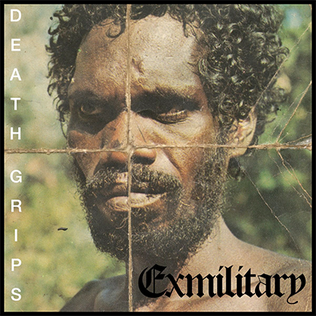
The 2011 mixtape 'Exmilitary' was the first real blast. Released for free, it quickly spread through online music circles because it sounded both primitive and futuristic. Its samples were abrasive and wide-ranging, its drums were jagged and unstable, and Ride's voice cut through everything with a hoarse authority. 'Guillotine' became the entry point for many listeners: a minimal, brutal track built around a heavy pulse and a video of Ride staring into the camera from the back of a moving car. It was not a traditional rap single, but it had the force of one because it reduced the band to a few unforgettable elements: voice, rhythm, threat, repetition, and image. 'Takyon' pushed the same formula into a more ecstatic register, while 'Beware' opened with a Charles Manson sample before turning into one of the band's most overwhelming statements of self-mythology. The record's impact came partly from how little it asked permission. It was too rap for noise purists, too punk for rap traditionalists, and too rhythmically addictive to be dismissed as simple provocation.
What made 'Exmilitary' important was not only its aggression, but its sense of design. Death Grips were often described as chaotic, yet their best work is rarely random. Hill's drumming background gave the music an understanding of momentum and impact. Morin's production compressed samples, synths, and distortion until they behaved like unstable machinery. Ride's writing used fragments, commands, threats, slogans, bodily images, paranoia, and sudden flashes of vulnerable dread. He did not usually explain himself in a narrative way. Instead, he built a language of pressure. That language became central to the band's identity: Death Grips songs often feel as if the listener has entered a system where surveillance, violence, money, technology, addiction, fame, and private fear are all feeding the same engine.
The surprise was that a major label wanted to step inside that engine. In 2012 Death Grips signed with Epic Records, an unusually volatile match between a major-label structure and a group built on confrontation. Their first album for the label, 'The Money Store', arrived in April 2012 and remains the clearest doorway into the band's world. Compared with 'Exmilitary', it was sharper, brighter, and more controlled, even when it sounded like it was collapsing. The production leaned harder into electronic architecture: synthetic basslines, metallic percussion, distorted hooks, and sudden negative space. 'Get Got' opened the album with a relatively nimble groove, showing that Death Grips could be catchy without softening their personality. 'The Fever' turned repetition into panic. 'I've Seen Footage' was almost danceable, driven by a fast, rubbery pulse and a chorus that felt like a corrupted pop hook. 'Hacker', the closing track, made the band's relationship to internet culture explicit without reducing it to novelty. It sounded like a party, a riot, and a browser window full of bad omens at the same time.
'The Money Store' is often treated as the band's definitive album because it balances extremity with precision. It does not merely throw noise over rap structures. It rebuilds those structures so that the noise becomes part of the groove. Ride's vocals are still harsh, but the album gives him more shapes to work against: skeletal electronic funk, industrial blasts, chopped digital textures, and hooks that seem to arrive from damaged pop music. The album also proved that Death Grips were not a one-record shock. Beneath the abrasive surface was a serious understanding of pacing. The record moves from compressed tension to open release, from blunt-force chants to strange moments of swing. For listeners who were used to hip-hop as lyrical display or rock as guitar-based rebellion, 'The Money Store' suggested another path: music that treated the body, the laptop, and the nervous system as one instrument.
The major-label relationship detonated almost immediately afterward. Epic had plans for further releases, but the band issued 'No Love Deep Web' themselves as a free download on October 1, 2012, before the label had approved the release. The episode became one of the defining Death Grips events: sudden, confrontational, and impossible to separate from the music itself. The cover caused controversy because of its provocative image, and the band's website went offline soon after the album appeared, leading to public dispute over whether the label had intervened. Epic dropped Death Grips shortly afterward. The incident turned the group from an aggressive experimental act into a case study in how an artist could make release strategy, image, and disobedience part of the work.
Musically, 'No Love Deep Web' was not simply a stunt. It was darker, more stripped down, and more claustrophobic than 'The Money Store'. Where the previous album often used bright synthetic hooks and frantic momentum, 'No Love Deep Web' favored emptier spaces, blunt drum programming, and a heavy sense of enclosure. Ride sounded closer to the listener, as if the walls had moved inward. 'Come Up and Get Me', 'Lil Boy', 'No Love', and 'Deep Web' all worked with dread rather than explosion. The album's force lies in its reduction. It removes some of the color from the band's palette and leaves a colder structure behind, making the record feel like a document of confinement, paranoia, and refusal. In the larger story of Death Grips, it is the point where their business decisions, visual choices, and sonic choices became inseparable.
After the Epic conflict, Death Grips established their own Third Worlds imprint in association with Harvest Records and continued operating with a mixture of independence and unpredictability. 'Government Plates', released in 2013, pushed them further away from the idea of a rap group in any conventional sense. Ride was sometimes less central in the mix, and the album often seemed driven by loops, textures, and digital repetition more than verses. 'You Might Think He Loves You for Your Money but I Know What He Really Loves You for It's Your Brand New Leopard Skin Pillbox Hat' opened with absurd force, while 'Birds' introduced one of the strangest moods in their catalog: brittle, eerie, almost nursery-rhyme-like in its melodic shape but still unstable. The record divided listeners because it felt less like a frontal assault and more like a set of hostile machines running in different rooms. Yet that discomfort was part of the point. Death Grips were refusing to let their identity harden into a marketable formula.
Their reputation for unpredictability also affected their live career. Death Grips shows were known for their intensity: Ride's presence, Hill's drumming, and Morin's electronics created the sensation of a band pushing itself to physical limits. But the group also developed a history of cancellations and evasive public behavior that became part of their mythology, sometimes to the frustration of fans and promoters. In 2013 they did not appear for a scheduled Lollapalooza aftershow in Chicago, and some disappointed audience members damaged equipment that had been set up onstage. The event added to the sense that Death Grips were not merely difficult to manage, but uninterested in the normal contract between performer, industry, and audience. That mythology could be thrilling from a distance and maddening up close.
The next major creative statement was 'The Powers That B', a double album released in full in 2015 after its first half, 'Niggas on the Moon', appeared in 2014. The first disc was built around heavily manipulated vocal contributions from Bjork, whose voice was chopped and transformed into texture across the tracks. The result was not a conventional collaboration, because Bjork's presence often functioned as a strange, flickering instrument rather than a featured vocal. On songs such as 'Up My Sleeves' and 'Black Quarterback', Death Grips sounded more elastic and abstract, less interested in brute force than in nervous motion. The second disc, 'Jenny Death', moved in a different direction, bringing guitars and live-band impact back toward the center. Tracks like 'Inanimate Sensation', 'On GP', and 'Centuries of Damn' gave the album a more rock-based physicality, with Hill's drumming and the distorted instrumentation pushing against Ride's most direct and exhausted-sounding performances.
'On GP' became one of the most striking songs in the band's catalog because it allowed a rare kind of emotional clarity without abandoning Death Grips' harshness. The song is not soft, but it is unusually exposed. Ride's delivery feels less like pure attack and more like confrontation with existence itself, set against a structure that builds from bleak reflection into cathartic force. In the context of a group often discussed through pranks, leaks, and spectacle, 'On GP' reminded listeners that Death Grips' extremity was not empty shock. Their best work could carry real weight, even when the language remained fragmented and the sound remained abrasive.
In July 2014, before the full release of 'The Powers That B', Death Grips announced that the band was over through a handwritten note posted online. They canceled scheduled dates, including a planned tour supporting Nine Inch Nails and Soundgarden. The announcement was perfectly in character: abrupt, theatrical, and hard to interpret. Yet like many Death Grips endings, it did not remain final. By 2015 the band had indicated that more music might come, and live activity resumed. This pattern of disappearance and return became a defining part of their later identity. Death Grips did not cultivate mystery in the old rock-star sense of interviews and carefully managed silence. Their mystery came from action: sudden uploads, confusing announcements, missing shows, unexpected returns, and a refusal to explain more than necessary.
'Bottomless Pit', released in 2016, felt like a re-consolidation of power. After the fractured structure of 'The Powers That B', it delivered a tighter, more immediate version of Death Grips: fast, dense, and viciously efficient. 'Giving Bad People Good Ideas' opened with a burst of speed and a vocal hook that seemed to mock accessibility while using it. 'Hot Head' was almost cartoonishly overloaded, moving from blasted syllables to digital spasms. 'Eh' was one of the band's most oddly restrained tracks, built around a mood of numb dismissal rather than constant attack. The album showed that Death Grips could revisit their core sound without simply repeating 'The Money Store'. It had the discipline of a group that knew exactly how to make chaos hit on time.
The band's most recent full-length studio album, 'Year of the Snitch', arrived in 2018 and sounded looser, stranger, and more grotesque. It included outside contributions and references that widened the album's texture, including involvement from filmmaker and producer Andrew Adamson on 'Dilemma' and turntablist DJ Swamp. The record often feels like Death Grips looking at their own mythology through a funhouse mirror. 'Death Grips Is Online' addresses the band's internet existence with a title that almost reads like a joke at the audience's expense, while 'Black Paint' brings back a jagged rock attack. Elsewhere, tracks such as 'Flies', 'Hahaha', and 'Linda's in Custody' lean into warped, unstable forms that feel deliberately ugly and playful at once. If 'The Money Store' was the cleanest expression of their power, 'Year of the Snitch' was closer to a haunted collage: messy by design, suspicious of polish, and full of sounds that seem to rot as they move.
Death Grips' creative process has always been difficult to describe in ordinary studio terms because the band presents the finished object more readily than the method. Still, certain patterns are clear. Hill's drumming is central even when live drums are not obvious; his sense of rhythm favors interruption, acceleration, and impact rather than steady support. Morin's production treats samples and electronics as physical material, not decoration. Ride writes and performs as if language is being forced through pressure. The vocals often blur the line between rap, chant, bark, and incantation. The group also understands visual presentation as part of composition. Their videos, covers, fonts, uploads, and public silence are not side products. They form the outer frame of the music.
Ride's public persona is especially important to the band's aura. He has rarely behaved like a conventional frontman. He gives little away, does not court celebrity, and often appears in images as a figure of intensity rather than explanation. That privacy has encouraged mythmaking, but the work itself gives a clearer picture than gossip can. In the music, Ride is not simply angry. He can be paranoid, ecstatic, disgusted, funny, apocalyptic, and strangely precise. His voice makes abstract production feel human, while the production makes his humanity feel unstable. Hill, by contrast, has a long public history as an experimental musician whose energy seems almost compulsive, and Morin's role as producer and visual architect gives the project its digital skeleton. Death Grips work because none of the three roles can be removed without changing the organism.
Their influence is now easy to hear, even when artists do not copy them directly. Death Grips helped make it more acceptable for rap, punk, noise, electronic music, and internet-born visual culture to exist as a single aggressive language. They arrived at a moment when genre boundaries were already weakening, but they pushed that collapse into something harsher and more physical. Their impact can be felt in experimental hip-hop, industrial rap, online underground scenes, and the broader willingness of younger artists to treat release strategy, visual identity, and audience confusion as part of the art. They also changed the way critics and listeners talked about extremity in popular music. Death Grips were not extreme because they were loud alone. They were extreme because they made instability feel organized.
The group's cultural position is unusual. They achieved critical acclaim and a devoted audience without becoming approachable in the usual sense. They had a major-label contract and destroyed it almost immediately. They became festival names while also becoming known for cancellations and unexplained absences. They released some of the most discussed experimental music of the 2010s while often refusing the explanatory rituals that usually accompany important records. This tension is central to their story. Death Grips are not merely a band with a strange career; the strange career is one of their materials.
Today, Death Grips are viewed as one of the most important experimental music acts of the 2010s, not because they made abrasive music, but because they made abrasive music feel necessary to a particular era. Their songs captured a world of overstimulation, surveillance, collapsing privacy, digital aggression, bodily anxiety, and economic pressure without turning those subjects into tidy commentary. They sounded like the inside of a system that had stopped pretending to be humane. Yet there is also pleasure in the work: grooves, hooks, absurdity, momentum, and the thrill of hearing musicians take risks that still land with precision. Death Grips matter because they made refusal into a sound, but also because beneath the refusal was craft. They built a body of work that remains hostile, funny, frightening, and alive, a catalog that still feels less like a finished chapter than a machine left running in the dark.