
Miles Davis
Biography
Miles Davis was born Miles Dewey Davis III on May 26, 1926, in Alton, Illinois, and grew up mainly in East St. Louis, a city close enough to the great river traffic of American music for blues, swing, church music, and modern urban life to press against one another. His father was a successful dentist, his mother was musical, and the family was comfortably middle class, a fact that mattered in the Davis story because it complicated one of the usual myths about jazz genius. Davis did not come from romanticized poverty. He came from discipline, expectation, and a household that could buy him a trumpet and lessons. The sound he eventually made on that trumpet, however, did not feel sheltered or decorative. It was narrow, vocal, wounded, elegant, impatient, and often startlingly direct. He learned early from local trumpeter Elwood Buchanan, who discouraged the heavy vibrato common among many players and pushed him toward a cleaner tone. That lesson became one of the foundations of Davis's art: a note did not have to be decorated to be devastating.
As a teenager, Davis played professionally around St. Louis and absorbed the language of big-band swing, but the decisive shock came in 1944, when Billy Eckstine's band visited town with a lineup that included Dizzy Gillespie and Charlie Parker. The young Davis heard musicians who seemed to be rebuilding jazz in real time, making the old harmonic roads twist into sharper, faster, stranger routes. Later that year he moved to New York to study at the Institute of Musical Art, the school later known as Juilliard, but the conservatory was never the real center of his education. He spent his nights looking for Parker and Gillespie on 52nd Street, entering the bebop world at the moment when it was becoming the most advanced language in jazz. He did study there for a time, but he grew frustrated with its distance from the music he was hearing in clubs. His true classroom was the bandstand, where mistakes happened in public and no one slowed the tempo for a student.
Davis's early association with Charlie Parker was both a blessing and a trial. Parker's music moved at a speed and density that could make even brilliant players sound uncertain, and Davis was not a trumpet virtuoso in the Dizzy Gillespie mold. He did not have Gillespie's acrobatic range or explosive comic brilliance. What he developed instead was a different form of authority. On Parker recordings from the mid-1940s, Davis can sound young, sometimes fragile, but already alert to space and contour. He seemed interested not only in how many notes could fit inside a chord change but in how one note could change the emotional temperature of a phrase. This was not a limitation he merely accepted. It became his method.
By the end of the 1940s, Davis was searching for another way out of bebop's heat. The sessions later collected as 'Birth of the Cool' were recorded in 1949 and 1950 with a nonet that included arrangements by Gil Evans, Gerry Mulligan, John Lewis, and others. The instrumentation, with French horn and tuba alongside trumpet, trombone, saxophones, piano, bass, and drums, gave the music a chamber-like color unusual for small-group jazz. It was not cool in the sense of passive or bloodless. It was controlled, arranged, and translucent, with the lines carefully voiced so that the ensemble seemed to breathe rather than shout. The project did not make Davis a star at the time, but it pointed to a lifelong pattern: when one idiom became crowded, he stepped sideways and found another frame for his sound.
The early 1950s were more difficult. Davis struggled with heroin addiction, a problem that damaged his reliability and momentum. He later described getting away from the New York scene and withdrawing at his father's home in Illinois, an account that has become part of the Davis legend even if the reality was surely harder and less tidy than the story sounds. The recovery was not just personal; it changed his career. By the middle of the decade he had regained force and focus, and his appearance at the 1955 Newport Jazz Festival became one of the turning points in his public life. During an all-star performance of 'Round Midnight', Davis played with a muted, concentrated lyricism that caught the attention of Columbia producer George Avakian. The performance helped lead to a Columbia contract and to the formation of one of the most important small groups in jazz history.
The first great Miles Davis Quintet, with John Coltrane on tenor saxophone, Red Garland on piano, Paul Chambers on bass, and Philly Joe Jones on drums, was a study in productive tension. Davis's trumpet often sounded reserved, dry, and decisive, while Coltrane's tenor was increasingly restless, building long, searching lines that seemed to test the limits of harmony. Garland's block chords and relaxed swing, Chambers's deep time, and Jones's snapping drums gave the group a balance between elegance and danger. Before fully moving to Columbia, Davis still owed recordings to Prestige, and in 1956 the quintet famously recorded a large body of material in two marathon sessions. Those performances were released as albums including 'Cookin'', 'Relaxin'', 'Workin'', and 'Steamin''. The anecdote has become part of jazz history because it shows Davis's practical intelligence as much as his artistry: he knew how to turn a contractual obligation into a permanent record of a working band at full speed.
With Columbia, Davis's profile grew, and so did the scale of his ideas. 'Round About Midnight', released in 1957, presented him as a major modern jazz artist to a wider public, but his collaboration with arranger Gil Evans opened an even broader landscape. 'Miles Ahead' placed Davis's flugelhorn against Evans's lush orchestral writing, creating music that was neither standard concerto nor ordinary jazz album. 'Porgy and Bess' followed in 1959, transforming Gershwin material into something more atmospheric and psychologically shaded than a simple jazz adaptation. Their later 'Sketches of Spain' drew from Spanish folk sources and Joaquin Rodrigo's 'Concierto de Aranjuez', but its power lay in the way Davis entered Evans's arrangements like a solitary human voice moving through vast scenery. These records showed that Davis was not only a small-group improviser. He could make drama out of texture, silence, and placement.
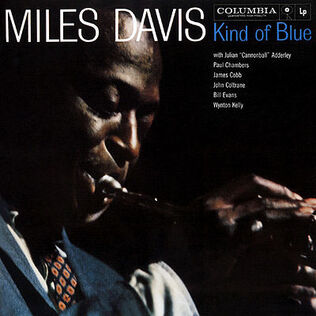
The 1959 album 'Kind of Blue' became the most widely celebrated record of Davis's career, but its importance is not only commercial. It changed how many musicians thought about improvisation. Instead of dense chord sequences demanding constant harmonic navigation, the album often used modes and static harmonic areas, giving the soloists room to build melody in a more open way. The sextet was extraordinary: Davis, John Coltrane, Cannonball Adderley, Bill Evans, Paul Chambers, and Jimmy Cobb, with Wynton Kelly appearing on 'Freddie Freeloader'. The recording process was famously direct. Davis brought sketches rather than fully rehearsed arrangements, and the musicians shaped the pieces quickly in the studio. That freshness can be heard in the music. 'So What' opens with a spare call-and-response figure before the band settles into an unhurried modal space. 'Blue in Green' and 'Flamenco Sketches' move with almost suspended time, while 'All Blues' turns a 6/8 feel into something both earthy and refined. The album's calm surface can hide how radical it was. Davis found a way to make experiment sound inevitable.
Davis was never content to live inside the success of one record. In the early 1960s, after personnel changes and personal difficulties, he assembled what became known as his second great quintet: Wayne Shorter on tenor saxophone, Herbie Hancock on piano, Ron Carter on bass, and Tony Williams on drums. Williams was still a teenager when he joined, and his drumming changed the center of the band. Instead of simply keeping time, he stretched, fractured, and redirected it. Shorter's compositions brought ambiguity and dark lyricism; Hancock's harmony was fluid and modern; Carter could anchor the music while remaining highly conversational. Albums such as 'E.S.P.', 'Miles Smiles', 'Sorcerer', and 'Nefertiti' did not abandon swing, but they made it unstable in thrilling ways. The band often played as if the tune were a living structure being reassembled during performance.
The second quintet's music is sometimes described as post-bop, but that term can sound too neat for how slippery the records are. On 'Miles Smiles', the group used space and implication with remarkable confidence. Themes could be brief, rhythms could turn inside out, and the soloists seemed less interested in taking turns than in collectively disturbing the ground beneath one another. On 'Nefertiti', the title track reversed a common jazz procedure: the horns repeat the melody while the rhythm section improvises beneath them. That structural decision says a great deal about Davis's mind. He was willing to make the obvious part fixed and let the hidden machinery become the site of freedom.
By the late 1960s, Davis was listening closely to electric instruments, rock, funk, and the changing sound of Black popular music. He did not move toward fusion as a polite crossover project. He moved because the old jazz club language no longer contained everything he wanted. 'Miles in the Sky' and 'Filles de Kilimanjaro' brought electric keyboards, electric bass textures, and longer grooves into his music, but 'In a Silent Way', recorded in 1969, was the real threshold. Producer Teo Macero played a crucial role in editing and shaping the tapes, turning studio performance into a larger form. The album is quiet on the surface, but its quiet is electric and humid. Joe Zawinul's title piece unfolds as a long atmosphere, while the musicians, including Wayne Shorter, Herbie Hancock, Chick Corea, John McLaughlin, Dave Holland, and Tony Williams, create a floating pulse that is neither traditional jazz swing nor rock backbeat. Davis's trumpet enters like a signal through mist.
Then came 'Bitches Brew', recorded in 1969 and released in 1970. It was not merely Davis adding rock rhythm to jazz harmony. It was a dense, layered, studio-shaped organism, with multiple electric keyboards, percussionists, bass patterns, and improvising voices colliding over long spans. The sessions involved musicians such as Wayne Shorter, Chick Corea, Joe Zawinul, John McLaughlin, Dave Holland, Jack DeJohnette, Lenny White, Don Alias, and others, with Macero again editing the material into its final form. The album divided listeners. Some jazz traditionalists heard betrayal; others heard the future. Its impact on jazz-rock fusion was enormous, but the record still sounds stranger than many of the smoother styles it helped make possible. Davis's role is often less like a conventional soloist and more like a director of weather, entering with short phrases, cues, and blasts of tone that organize the storm around him.
The electric period also revealed Davis's appetite for confrontation. Onstage in the early 1970s, his bands could be loud, dark, and physically intense. Albums such as 'A Tribute to Jack Johnson', 'On the Corner', 'Get Up with It', 'Agharta', and 'Pangaea' pushed toward funk, rock, electric noise, dense percussion, tape editing, and abrasive repetition. 'On the Corner', released in 1972, was especially controversial. Davis wanted to connect with younger Black listeners who were not necessarily following acoustic jazz, and the album's grooves were compressed, streetwise, and deliberately resistant to polite jazz expectations. Critics at the time often dismissed it, but later generations heard connections to hip-hop sampling logic, electronic repetition, and downtown funk experimentation. The record's reputation changed dramatically over time, becoming one of the clearest examples of Davis being dismissed in the present for music that later listeners understood more readily.
Davis's personality could be magnetic, funny, severe, and difficult. He was famous for turning his back on audiences, for speaking in a rasp after he strained his voice while recovering from throat surgery, and for refusing the role of grateful entertainer. Some of this behavior was read as arrogance, and sometimes it surely was harsh. But it also belonged to a deeper refusal: Davis did not want to soothe listeners into thinking they owned him. He challenged musicians too. He often gave minimal instructions, forcing players to listen harder and make decisions. Many major artists passed through his groups, not because he simply hired talent, but because he created situations where talent had to mutate. Coltrane, Cannonball Adderley, Bill Evans, Wayne Shorter, Herbie Hancock, Chick Corea, Keith Jarrett, John McLaughlin, Dave Holland, Jack DeJohnette, Marcus Miller, and many others left his orbit changed.
In 1975, after years of health problems, drug use, exhaustion, and creative pressure, Davis withdrew from public performance. The late 1970s became a period of isolation. For an artist who had repeatedly defined the future of jazz, the silence was startling. When he returned on record in 1981 with 'The Man with the Horn', the response was mixed, but the return itself mattered. Davis was no longer the same player physically, and the jazz world around him had changed. Younger musicians were reviving acoustic traditions, while pop, funk, and electronic production were moving quickly. Davis did not try to become a museum version of his 1959 or 1965 self. He entered the 1980s with synthesizers, electric bass, programmed textures, and a new public image built around painting, fashion, and a sharper pop-cultural presence.
The later period is uneven, but it is not disposable. 'Star People' retained blues feeling within an electric frame. 'Decoy' leaned into synthesizer-driven funk. 'You're Under Arrest' included versions of contemporary pop songs, including material associated with Michael Jackson and Cyndi Lauper, a move that baffled some listeners but fit Davis's long habit of pulling the present into his own language. His collaboration with bassist and producer Marcus Miller became especially important on 'Tutu', released in 1986. Much of that album was constructed around Miller's compositions and studio production, with Davis adding trumpet over programmed grooves and sleek electronic surfaces. For listeners attached to the acoustic quintets, this could feel too polished. Yet Davis's muted tone still cut through the machinery with unmistakable identity. Even when the setting changed radically, a few notes could reveal him.
One of the most telling late-career events came in 1991, when Davis agreed to revisit music from his Gil Evans collaborations at the Montreux Jazz Festival with Quincy Jones conducting. Davis had long resisted looking backward, and the performance was unusual precisely because it acknowledged a past he usually preferred to outrun. He was physically fragile, and he died later that year, on September 28, 1991, in Santa Monica, California. His death closed one of the most restless careers in twentieth-century music, but it did not settle the argument around him. Davis had left behind too many versions of himself for a single monument: bebop apprentice, cool modernist, modal architect, small-group radical, electric provocateur, funk experimenter, late pop modernist.
What makes Miles Davis unique is not simply that he changed styles. Many artists change styles. Davis changed the environment in which other musicians imagined style itself. He understood personnel as composition: choosing the right drummer, pianist, or saxophonist could alter the future more deeply than writing a manifesto. He also understood absence. His trumpet sound often depended on what he withheld, the breath before a phrase, the note left unplayed, the way a mute could turn volume into intimacy. In a music famous for virtuosity, he proved that authority could come from restraint, timing, and tone.
His influence is almost impossible to contain within jazz. 'Birth of the Cool' helped shape cool jazz and arranged small-group modernism. 'Kind of Blue' became a central text for modal improvisation. The second quintet opened new rhythmic and structural possibilities for post-bop. 'In a Silent Way' and 'Bitches Brew' changed the relationship between jazz, rock, electricity, and the studio. 'On the Corner' found later admirers among funk, hip-hop, electronic, and experimental musicians. Davis's career is not a straight line of progress, and not every experiment was equally successful. But the failures matter too, because they came from movement rather than comfort.
Today, Miles Davis is remembered not only as one of the most important trumpeters in jazz, but as one of the great organizers of musical change. He could be unsparing, elusive, stylish, and combative, but the records show a deeper consistency beneath the surface shifts. He kept asking what the music needed next, then found musicians brave enough to answer with him. His best work does not feel preserved behind glass. It still feels active, as if the band has just entered the room, the tune is barely explained, and Davis is about to raise the horn and make one note do the work of many.