
Radiohead
Biography
Radiohead began as five school friends in Abingdon, Oxfordshire, a place far removed from the usual mythic centers of British rock. Thom Yorke, brothers Jonny and Colin Greenwood, Ed O'Brien, and Philip Selway met at Abingdon School in the 1980s and first played together under the name On a Friday, a name drawn from the day they usually rehearsed. They were not assembled by a scene or a manager. They grew out of the patient, awkward chemistry of people who had learned one another's habits before anyone outside Oxford cared. Yorke brought a voice that could sound wounded, accusatory, beautiful, and alien within the same phrase. Jonny Greenwood, younger than the others, became the disruptive force, as likely to attack a song with noise as decorate it. O'Brien added atmosphere, harmony, and a guitarist's instinct for space. Colin Greenwood and Selway gave the band its steadiness, keeping even the most unstable music from floating away.
The group paused while members went to university, then resumed in Oxford in the early 1990s. After signing to EMI, they changed their name to Radiohead, taken from the Talking Heads song 'Radio Head'. Their first single, 'Creep', arrived in 1992 and at first seemed more like an odd flare than the start of a major career. It did not immediately make them stars in Britain, but it traveled. Built on a quiet-loud structure, self-lacerating lyrics, and Jonny Greenwood's harsh guitar stabs before the chorus, the song became a slow international breakthrough. Its success was both a blessing and a trap. Radiohead were suddenly known for one bruised anthem, and the pressure to either repeat it or escape it became one of the defining tensions of their early career.
Their debut album, 'Pablo Honey', released in 1993, caught a young band still close to the guitar-rock language of its time. It had force, hooks, and flashes of Yorke's emotional extremity, but it did not yet show the architecture, patience, or restless imagination that would define Radiohead later. The band toured heavily behind it, and the grind hardened them. What made the next step remarkable was not that they improved, but that they refused to become the smaller band the industry could easily have made from 'Creep'. Instead of building a career around one damaged hit, they began looking for a wider, stranger sound.
'The Bends', released in 1995, was the first Radiohead album that truly sounded like a band discovering its scale. Produced by John Leckie, with Nigel Godrich working as engineer before becoming their key studio collaborator, the record kept the guitars but gave them drama, depth, and weather. Songs such as 'Fake Plastic Trees', 'High and Dry', 'Just', 'My Iron Lung', and 'Street Spirit (Fade Out)' showed a group able to turn anxiety into shape. Yorke's writing moved from the blunt self-disgust of 'Creep' toward more cinematic scenes of exhaustion, artificiality, and spiritual hunger. The album also captured the band pushing against its own success: 'My Iron Lung' has often been read as a bitter response to the shadow of 'Creep', a song about being kept alive and trapped by the very thing that had made them visible.
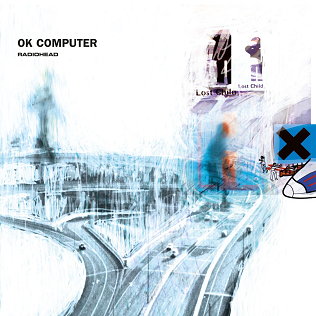
The real transformation came with 'OK Computer' in 1997. Recorded partly at St Catherine's Court, actress Jane Seymour's mansion near Bath, and produced by the band with Nigel Godrich, the album sounded less like a conventional studio rock record than a cracked transmission from the end of the century. Its themes were not futuristic in a simple science-fiction sense. They were about modern life already becoming unreal: motorways, offices, screens, air travel, political slogans, consumer language, and emotional paralysis. 'Paranoid Android' moved through sections like a miniature suite, refusing the economy of a normal single. 'Exit Music (For a Film)' began as a near-whisper and became a slow collapse. 'No Surprises' wrapped dread in a lullaby. 'Karma Police' made accusation feel communal and surreal. The record's power came from the way it made unease sound grand without making it heroic.
The supporting tour for 'OK Computer' pushed the band into a kind of global visibility that did not suit their temperament. The documentary 'Meeting People Is Easy' captured the promotional cycle as a blur of interviews, hotels, performances, and visible depletion. Radiohead were celebrated as the serious rock band of the moment, but that praise created another trap. Just as 'Creep' had threatened to reduce them to one song, 'OK Computer' threatened to reduce them to one idea: the saviors of intelligent guitar rock. Their response was to dismantle the very language that had brought them acclaim.
The sessions that led to 'Kid A' and 'Amnesiac' were difficult, fragmented, and decisive. Yorke had become less interested in conventional guitar music and more drawn to electronic composition, jazz, modern classical music, and the idea of cutting the band away from obvious rock gestures. The others had to find new roles inside that shift. Jonny Greenwood became increasingly important not only as a guitarist but as a colorist and arranger, using the Ondes Martenot, strings, and electronic textures. The band worked with loops, edits, processed sounds, and studio construction rather than simply recording live performances of finished songs. The process created tension, but it also rescued them from repetition.
'Kid A', released in 2000, was greeted as a shock because it refused to perform the duties expected of a follow-up to 'OK Computer'. There was no easy rock single, no simple continuation, and often no conventional guitar center. 'Everything in Its Right Place' opened the album with electric piano and fractured vocals, immediately announcing a different grammar. 'The National Anthem' rode a distorted bass line and chaotic brass. 'How to Disappear Completely' turned alienation into a suspended, orchestral lament. 'Idioteque' brought cold electronic rhythm into the heart of the record. What made 'Kid A' endure was not merely its experimentation, but its emotional precision. It used machines, abstraction, and fragmentation to describe a nervous system under pressure.
'Amnesiac', released in 2001 from the same broad creative period, was not simply a leftovers record, even if it shared origins with 'Kid A'. It felt murkier, more haunted, and at times more openly rooted in song form. 'Pyramid Song' moved with an uncanny rhythmic feel and placed Yorke's voice over piano, strings, and a sense of floating time. 'You and Whose Army?' began like a ghostly cabaret before swelling into menace. 'Life in a Glasshouse' closed the album with jazz funeral colors, helped by the presence of Humphrey Lyttelton's band. Together, 'Kid A' and 'Amnesiac' changed how Radiohead were understood. They were no longer a guitar band that had become ambitious; they were a band willing to rebuild itself around discomfort.
'Hail to the Thief', released in 2003, gathered many of Radiohead's methods into a more sprawling, agitated form. Recorded comparatively quickly in Los Angeles with Godrich, it mixed guitars, electronics, political dread, and nursery-rhyme menace. Its title and mood were often heard in the context of early-2000s political anxiety, though the band resisted reducing it to a simple protest album. '2 + 2 = 5' opened with the sound of a band plugging in and gathering force, then exploded into panic. 'There There' became one of their great rhythm-driven songs, with interlocking drums and guitars building toward release. The album can feel overfull, but that excess is part of its character: it catches Radiohead in a state of alarm, unwilling to choose between human performance and electronic unease.
After 'Hail to the Thief', Radiohead's contract with EMI ended, and the band entered one of the most important independent phases in modern popular music. Instead of rushing into another major-label cycle, they worked slowly and privately on what became 'In Rainbows'. The album, released in 2007 through a pay-what-you-want download model before its physical release, became famous for its distribution, but its music mattered just as much. It was warmer, more sensual, and more physically graceful than the records immediately before it. The decision to let listeners choose their price was not a gimmick pasted onto weak material; it was attached to one of their most inviting albums.
'In Rainbows' refined Radiohead's complexity into flow. '15 Step' used an irregular rhythmic feel without sounding like a math exercise. 'Bodysnatchers' brought back distorted rock energy, but with a wired, trapped intensity. 'Nude', a song with roots stretching back years, became a slow-motion study in restraint, with Colin Greenwood's bass line and Yorke's vocal carrying much of the emotional weight. 'Weird Fishes/Arpeggi' built from interlocking guitar patterns into a song that seemed to move like current. 'Reckoner' placed falsetto, percussion, and harmonic shimmer into a form that felt both intricate and natural. If 'Kid A' proved Radiohead could abandon expectations, 'In Rainbows' proved they could absorb their experiments into music that felt almost effortless.
The band's method had become unusually democratic and unusually demanding. Yorke often supplied sketches, words, melodic fragments, or rhythmic ideas, but Radiohead's finished music depended on collective transformation. Jonny Greenwood might bend a song through arrangement or texture; Colin Greenwood could make a track's emotional direction clear through bass movement; Selway's drumming, sometimes understated, often determined whether a song felt human, mechanical, or suspended between the two; O'Brien's guitar and voice added the glowing edges around the arrangements. Nigel Godrich's role was also central. More than a producer brought in to polish the band, he became a long-term interpreter of their instincts, helping them decide when a track needed density, when it needed subtraction, and when a mistake contained the point.
'The King of Limbs', released in 2011, was smaller and more rhythmically obsessive than its predecessor. Built with loops, samples, and layered patterns, it divided listeners who expected either the emotional openness of 'In Rainbows' or the dramatic scale of earlier records. Yet its best moments show another side of the band: the twitching, woodland percussion of 'Bloom', the uneasy momentum of 'Morning Mr Magpie', the open-air melancholy of 'Codex', and the gradual lift of 'Separator'. The songs gained new force in performance, especially through the expanded live arrangements documented around that period. Rather than a grand statement, the album felt like Radiohead investigating motion, repetition, and the blurred line between programmed rhythm and band interplay.
'A Moon Shaped Pool', released in 2016, carried a different emotional temperature. Recorded with Godrich at locations including La Fabrique in France, RAK Studios in London, and the band's Oxfordshire studio, it prominently featured Jonny Greenwood's string and choral arrangements, performed by the London Contemporary Orchestra. The album drew together new work and older songs that had lived in Radiohead's orbit for years. 'Burn the Witch' paired anxious strings with political menace. 'Daydreaming' unfolded with glacial piano and reversed textures, its video directed by Paul Thomas Anderson. 'Decks Dark' and 'Present Tense' moved with quiet dread and rhythmic delicacy. The closing version of 'True Love Waits', long known to fans from live performances, was transformed into something skeletal and devastating, built around piano figures rather than the acoustic-guitar form many listeners had known.
The circumstances around 'A Moon Shaped Pool' made the record feel especially heavy, though the band did not present it as a simple diary. Around this period, Yorke separated from his longtime partner Rachel Owen, who died of cancer in 2016, and Godrich's father also died during the making of the record. It would be careless to turn those facts into a complete explanation of the music, but the album's atmosphere of loss, memory, and slow motion is impossible to miss. What is striking is how controlled the record remains. Radiohead did not dramatize grief through spectacle; they let absence sit inside the arrangements.
Outside the albums, Radiohead's story includes a series of choices that shaped the culture around them. Their limited online release strategies, their resistance to ordinary promotion, and their careful visual identity with artist Stanley Donwood made them feel less like a normal rock brand than an evolving artistic system. Donwood's artwork, from the unsettled landscapes of the late 1990s to the data-saturated or abstract images of later projects, became part of how listeners imagined the music. The band also treated live performance as a place of reinvention. Songs often changed shape onstage, and material that seemed cold or fractured in the studio could become physical, even explosive, in concert.
Radiohead's members also developed separate creative lives that fed back into the band's identity. Jonny Greenwood became a major film composer, especially through his work with Paul Thomas Anderson, using orchestral writing, dissonance, and texture in ways that made sense alongside his Radiohead contributions but stood apart from them. Thom Yorke released solo albums and electronic projects that explored rhythm, voice, and anxiety with fewer band constraints. Philip Selway and Ed O'Brien made solo records that revealed quieter parts of their musicianship, while Colin Greenwood's playing remained one of the least flashy but most essential elements of Radiohead's sound. In 2021, Yorke and Jonny Greenwood formed the Smile with drummer Tom Skinner, creating music that carried Radiohead-like tension while moving through a leaner, different chemistry.
After touring behind 'A Moon Shaped Pool', Radiohead entered the longest quiet stretch of their career. They were inducted into the Rock and Roll Hall of Fame in 2019, with only O'Brien and Selway attending the ceremony, a response that fit the band's wary relationship with rock institutions. Reissues such as 'OKNOTOK 1997 2017' and 'Kid A Mnesia' revisited crucial periods without turning the band into a museum piece. The archival releases mattered because they showed how much strong material had existed around the edges: songs like 'I Promise', 'Lift', and 'Man of War' had circulated in fan mythology for years before official release, and their appearance complicated the idea that Radiohead's history was only the sequence of studio albums.
Radiohead returned to the stage in 2025 with a limited European tour, their first live run since 2018, a reminder that the band had never formally ended even when its members were busy elsewhere. By then, their influence had become unusually broad. Alternative rock bands learned from their willingness to warp guitar music. Electronic and experimental artists recognized their use of texture, rhythm, and studio editing. Songwriters absorbed Yorke's gift for making private unease feel connected to public systems. Their shadow can be heard not only in artists who imitate their atmosphere, but in the wider expectation that a major band can change language from album to album and bring an audience with it.
What makes Radiohead rare is not only that they made several acclaimed records, but that they repeatedly escaped the identities those records created. They survived being the band of 'Creep', then the band of 'OK Computer', then the band that shocked the rock world with 'Kid A'. Each time, they treated success as a problem to solve rather than a place to rest. Their music is often described as anxious, but its deeper quality is vigilance: a refusal to let beauty become easy, to let technology feel neutral, or to let emotion arrive without distortion. Across their career, Radiohead turned discomfort into form, and in doing so became one of the defining bands of the modern era.